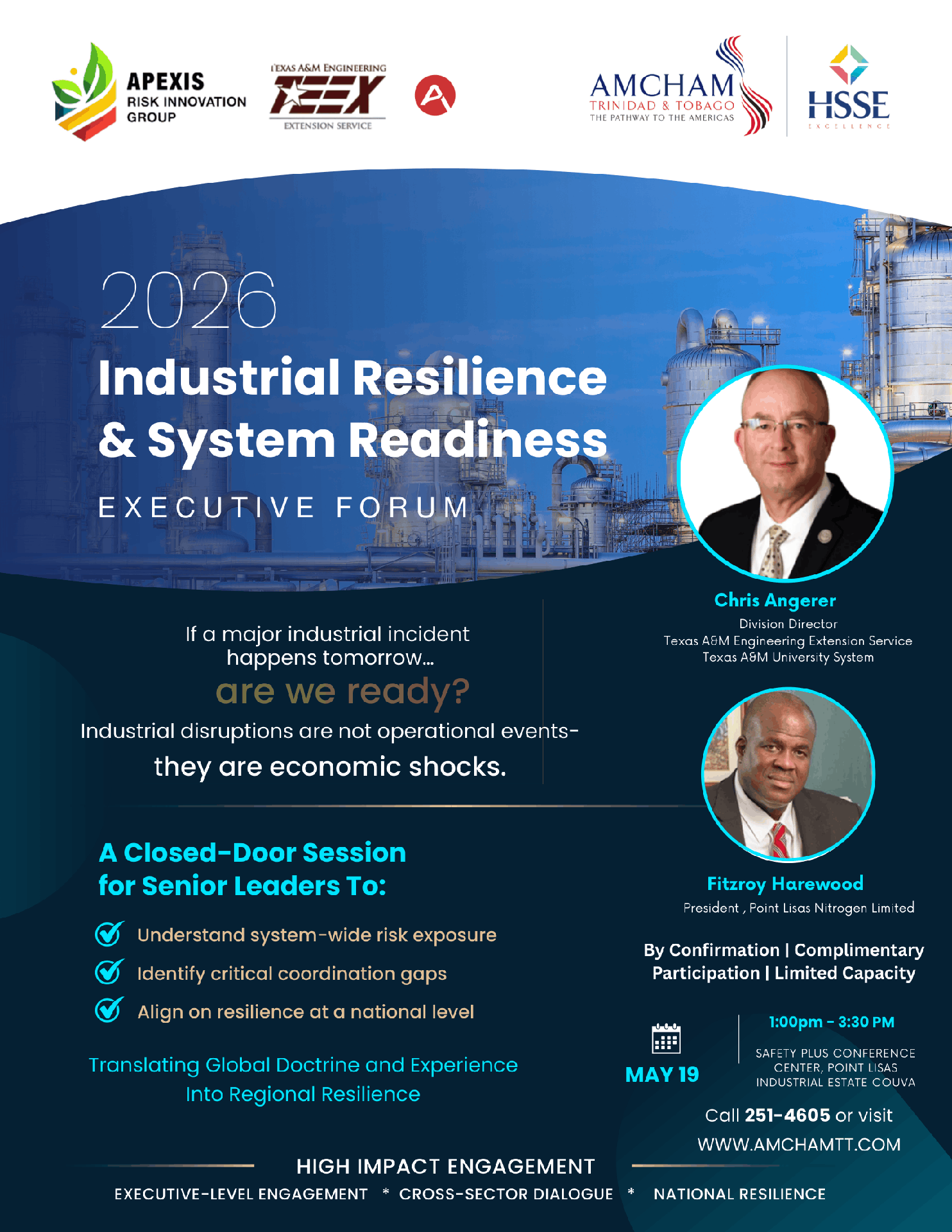
Industrial Resilience & System Readiness
Executive Forum
A high-impact workshop that addresses executive-level alignment on systemic industrial resilience—equipping leaders with the governance strategies, command architecture, and continuity frameworks required to navigate disruption and sustain performance in high-risk operating environments.
Event Details
Trinidad & Tobago operates as a highly industrial, energy-dependent, interdependent economy, but its resilience architecture has not been stress-tested at a systemic, cross-sector level. In other words: We manage risks within sectors. But we have not fully examined risk convergence across sectors.
In energy-dense economies, industrial disasters are not isolated operational events, they are systemic economic shocks. The real vulnerability is not the fire, spill, or cyber incident itself. It is the cascading failure across oil & gas infrastructure, water, power, ports, finance, transport, supply chain &logistics (air, sea, land), public health epidemic, communications networks, natural disasters, governance and civil unrest.
Most organisations plan for:
- Site-level emergencies
- Regulatory compliance
- Internal business continuity
Few economies plan for:
- Cross-sector cascading failure
- Pre-negotiated unified command between government and private industry
- Infrastructure stress layered on industrial incident
- Emerging hazard convergence
The insight is this: Resilience in complex industrial economies must be architected, not assumed.
- System Interdependencies & Cascading Risk
- Financial Systems Exposure
- Infrastructure Control Systems
- Command, Control & Cross-Sector Coordination
- Cyber & Digital Disruption and Resilience in Industrial Environments
- Executive Decision-Making Under Disruption
- Continuity of Operations at a System Level
- Shared understanding of systemic vulnerabilities and interdependencies
- Identification of priority coordination and response gaps
- Alignment on immediate and medium-term resilience priorities
- Building a sustained engagement platform anchored by Apexis (technical) and AMCHAM (convening authority)
Primary Outcome: Establishment of a Cross-Sector Industrial Resilience Working Group (IRWG)
- Understand true risk exposure beyond the organization- Gain visibility into how external dependencies (power, fuel, ports, cyber systems, government coordination) impact operations.
- Stress-test leadership readiness under real crisis conditions -Evaluate how decisions would be made at the executive level during a complex, multi-system disruption.
- Access key decision-makers across sectors -Engage directly with CEOs, government officials, and infrastructure leaders whose actions affect response and recovery.
- Identify gaps in coordination and response before an incident occurs- Uncover where alignment breaks down across sectors and where vulnerabilities exist.
- Influence how cross-sector resilience is shaped going forward- Contribute to the formation of a working group and future initiatives that will define coordination and response frameworks.
- Strengthen governance and board-level risk oversight - Address industrial disruption as a strategic and economic issue, not just an operational concern.
- High-value use of executive time - Participate in a focused, closed-door session with senior leaders, no media, no noise, only meaningful discussion and outcomes.
A strategic, high-trust engagement platform that enables alignment, coordination, and resilience across complex industrial systems at a national level.
This forum calls on executive leaders to move from fragmented, sector-based risk management toward integrated, governance-driven industrial resilience that protects national economic continuity.
- Industrial Disasters Are Economic Events
- Interdependence Is the Real Risk Resilience Multiplier
- Governance & Command Clarity Determine Outcomes
- Stress-Testing Prevents Systemic Surprise
- Resilience Must Be Engineered — Not Assumed