The Missing Link: Rethinking Networks to Bridge the Connection Gap in Economic Transformation By Andrea Davis
LINKAGE Q1 (2026) - REVITALISATION & TRANSFORMATIONwe often look to innovation, investment and policy as the primary drivers of economic transformation. These are critical levers, shaping direction, unlocking capital and creating the conditions for growth.Yet across many economies, including Trinidad and Tobago, progress continues to fall short of potential. High-quality ideas and projects stall, capable organisations struggle to scale and promising opportunities remain underleveraged.This is not a question of capability; increasingly, it is a question of connection. The real constraint is rarely the absence of talent, resources or ambition. It is the absence of intentional, high-value networks that align these elements toward shared outcomes. This is the connection gap and bridging it may well be the missing link in economic transformation.The Connection Gap in ContextResearch in economic development consistently highlights the role of networks in driving growth. The World Bank has long argued that productivity and innovation are shaped not only by firm-level capability, but by how effectively firms connect within broader ecosystems. Collaboration across firms, institutions and sectors is a defining feature of high-performing economies.In many small and developing economies, however, those connections remain fragmented. Industries operate in silos. Small and medium-sized enterprises struggle to access the networks that provide market reach, financing and technical expertise. Public and private sector initiatives often run in parallel rather than in partnership. Value exists, but is not fully activated.Trinidad and Tobago’s energy sector offers a clear local illustration of what the alternative looks like. The country’s position as a leading regional producer of liquefied natural gas has rested not only on resource availability, but on the integration of operators, service providers, regulators and international partners. Collaboration between multinational energy companies, local suppliers, technical institutions and government agencies has enabled knowledge transfer, local capacity building and the growth of downstream industries—a reminder that sustained performance is rarely driven by individual actors alone, but by how effectively they are connected within a broader system.From Networking to Network Design
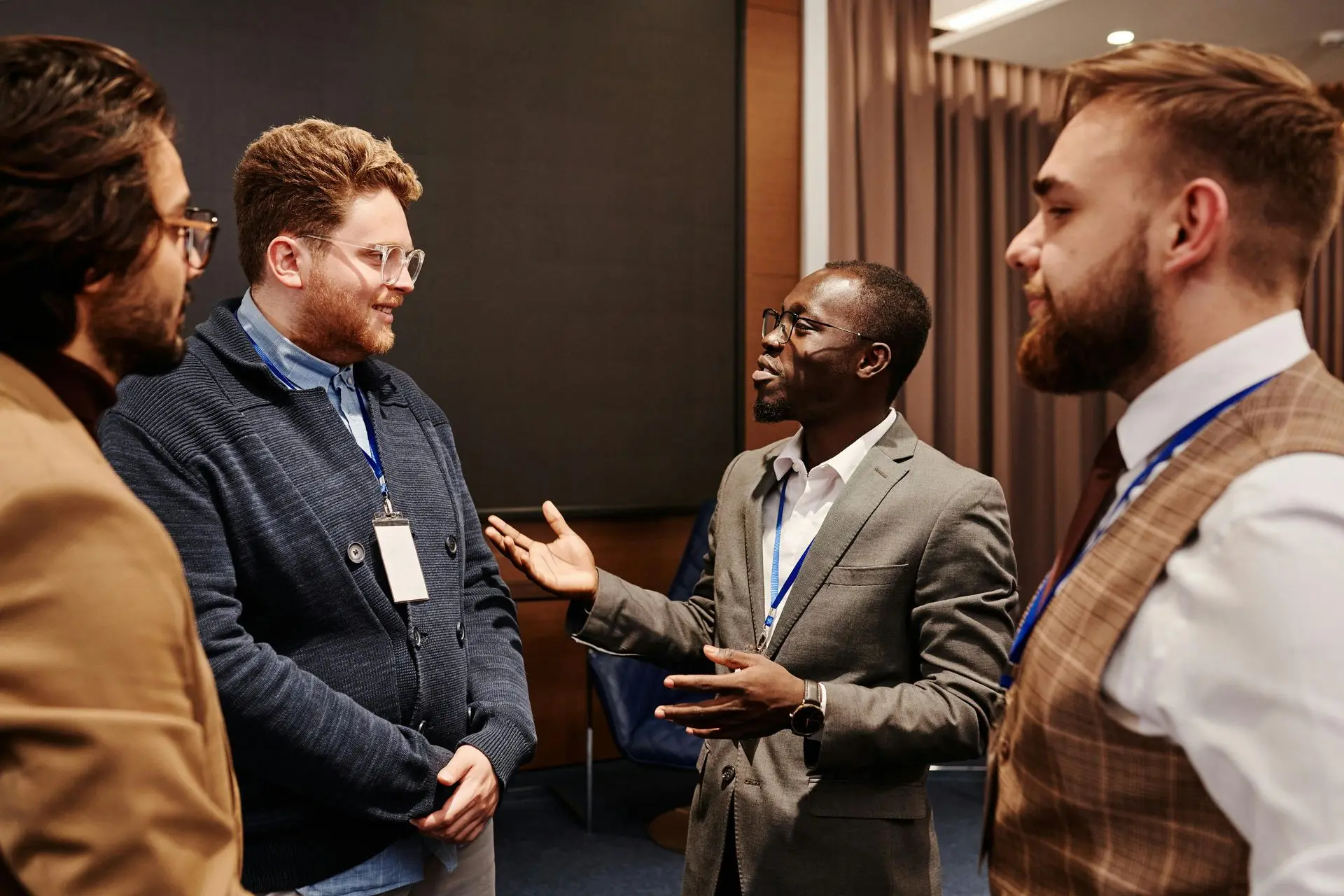
Part of the challenge lies in how networking itself is understood. Traditionally, networking is treated as an activity: limited to attending events, making introductions, exchanging contacts. While useful, this approach is largely informal and dependent on chance, it rarely produces consistent, system-level outcomes.What is required instead is a shift from networking as activity to network design as strategy. Network design is intentional: it begins with a clear understanding of desired outcomes—market expansion, innovation, policy development, sector growth—and works backward to identify the actors, capabilities and relationships required. American sociologist Mark Granovetter captured part of this insight decades ago in his concept of the ‘strength of weak ties’: access to diverse, extended networks dramatically improves access to opportunity and information. In high-performing environments, networks are not accidental. They are by design.The Ripple Effect of Strategic ConnectionWhen networks are intentionally designed, their impact extends well beyond any single transaction. This is what I call the Ripple Effect: the principle that one well-aligned connection rarely stays contained. It moves outwards, unlocking access to new markets, partnerships and capabilities. Over time, those connections compound, expanding opportunities not only for the individuals or organisations directly involved, but for the broader ecosystem around them.This is evident in global innovation hubs such as Silicon Valley, where dense networks between entrepreneurs, investors, universities and corporations have enabled rapid scaling of ideas. Singapore offers a different model: a deliberate, state-led effort to integrate government, industry and academia into a tightly coordinated ecosystem. In each case, success is not solely a function of resources or policy, but of the strength and intentionality of the networks underneath.A Framework for Bridging the Connection GapThe Ripple Effect describes what intentional networks make possible; the next question is how to design them in practice. The Ripple framework offers five working elements:1. Intent: Define the outcome the network is meant to achieve. Clarity of purpose distinguishes a strategic network from a contact list.2. Access: Identify the gaps. Which capabilities, perspectives or stakeholders are currently missing from the conversation?3. Alignment: Build around shared value. Resilient networks are those where participants have complementary strengths and a genuine stake in collective success.4. Value Creation: Move beyond exchange. Effective networks are measured not by the contacts they hold, but by what they build together.5. Activation: Convert connection into outcomes. Relationships must lead to action and measurable impact, or the network remains potential rather than performance.A network’s effectiveness is rarely a function of its size, but of its relevance, diversity and ability to mobilise the right relationships toward a shared goal.Networks as Economic InfrastructureViewed strategically, networks function as a form of economic infrastructure. They enable the flow of information, capital and opportunity. They reduce friction between sectors, accelerate innovation and improve resilience in the face of disruption.Germany offers a powerful illustration. The strength of its ‘Mittelstand’—the country’s economic backbone of small and medium-sized firms driving much of the country’s export economy—rests on dense networks linking firms to research institutions, industry associations and global markets. Individually, these firms would be modest players. Collectively, they form one of the most competitive industrial bases in the world.The lesson is clear: economic strength is not only a function of individual performance, but of system-level connectivity.The Leadership Imperative
Bridging the connection gap is not a passive process. It requires deliberate leadership, and it operates at every scale. The same logic that shapes economies shapes organisations, and the same logic that shapes organisations shapes careers.Leaders shape networks through the spaces they create, the relationships they prioritise and the connections they choose to enable. Every introduction, partnership and collaboration contributes to how opportunities flow within a team, an organisation and ultimately an economy. The same principle applies at the individual level. Intentional networks are often the difference between competence that goes unnoticed and competence that compounds into opportunity, opening doors to mentorship, increasing visibility, and translating, over time, into promotions, new business and expanded influence. The strongest careers, like the strongest economies, are rarely built in isolation.This places a responsibility on leaders to move beyond internal management and take an active role in ecosystem development, and on every professional to think more deliberately about the networks they are building. The questions are the same in either case:· Who is not currently connected, but should be?· Where are opportunities for collaboration being quietly missed?· What platforms can bring diverse stakeholders into the same conversation?In an increasingly interconnected world, leadership extends beyond organisational boundaries to the ability to connect, align and activate networks that drive impact beyond the firm.How does this translate?In practice, this is what I see consistently: the leaders and organisations that move fastest are not necessarily those with the most contacts, but those who are most deliberate about which relationships they cultivate. Networks designed around clear intent and complementary capability behave less like address books and more like infrastructure, quietly enabling everything that flows through them.Designing What Comes NextOrganisations such as AMCHAM T&T already understand this intuitively. The very name of this publication—LINKAGE—points to what is most needed in this moment: not more isolated effort, but more deliberate connection between the people, sectors and institutions that will shape the next phase of growth.As Trinidad and Tobago pursues revitalisation and transformation, the focus must extend beyond building capacity to connecting it. The talent, the resources and the ambition all exist. What remains is the discipline to align them through intentional, high-value networks—and the leadership to make those connections deliberate rather than accidental.Because transformation is not simply about what we build. It is about how effectively we connect what already exists, and how intentionally we design those connections.Bridging the connection gap may well be the missing link that unlocks the next phase of growth.
ABOUT THE AUTHOR Andrea Davis is the CEO at Anai Business Solutions Ltd.