AI + Workforce Transformation: Preparing Trinidad and Tobago for the Augmented Economy By John Outridge
LINKAGE Q1 (2026) - REVITALISATION & TRANSFORMATIONAs Trinidad and Tobago seeks to revitalise its economy, the focus is often placed on new industries, capital investment and diversification strategies. Yet, one of the most profound forces shaping the future of economic growth is not just what industries we build, but how work itself is being redefined.The global economy is entering a new phase, one defined not just by digital transformation, but by labour transformation. AI will reshape; How work is structured? How value is created? How countries compete?For Trinidad and Tobago, the opportunity is not to catch up, but to leap forward.By focusing on:
Task-level transformation
Workforce augmentation
Real world application of AI
the country can build a more resilient, competitive, and inclusive economy. For Trinidad and Tobago, the implications are clear: the next phase of economic transformation will be driven not just by adopting AI, but by re-engineering the workforce around it.From Jobs to Tasks: The Real Impact of AIA defining insight from global research is that AI does not eliminate entire jobs, it targets tasks within jobs.Every role is a bundle of activities:
Administrative and repetitive tasks
Analytical and data-driven tasks
Human-centred and judgment-based tasks
AI is highly effective at automating the first two categories, but far less capable in the third. This means the future of work is not about job loss, it is about task redistribution.For Trinidad and Tobago, this reframes the national question:How do we redesign jobs so that humans focus on higher-value work while AI handles the rest?Source- https://chamath.substack.com/p/deep-dive-ai-effect-on-labor-marketThe Productivity Multiplier: Why AI Expands OpportunityEvidence globally shows that AI adoption correlates with:· Higher productivity· Faster company growth· Increased demand for skilled workersAI is not just a cost-cutting tool, it is a capability multiplier.A single worker, augmented by AI, can now:
Process more data
Serve more customers
Make faster and better decisions
For a small, open economy like Trinidad and Tobago, this is transformative. It allows local firms to compete globally without scale disadvantages.The Uneven Impact: A Two-Speed Labour MarketAI’s impact is not uniform.Roles most exposed:
Administrative and clerical work
Entry-level finance and reporting
Structured customer service
Roles more resilient:
Skilled trades and physical work
High-touch services
Strategic and leadership roles
This creates a two-speed labour market:1. Rapid transformation in knowledge work2. Gradual augmentation in physical and service sectorsFor Trinidad and Tobago, this means the services economy will transform first, particularly:
Financial services
Government operations
Business Process Outsourcing and shared services
The Rise of the Augmented WorkerThe defining worker of the next decade is not replaced by AI, but amplified by it.The “augmented worker”:
Uses AI tools to enhance productivity
Focuses on higher-value decision-making
Combines domain expertise with digital capability
This is already happening:
Analysts using AI for real-time insights
Customer service agents supported by AI copilots
Engineers leveraging predictive tools
The Skills Shift: From Execution to OrchestrationThe future workforce does not require everyone to be engineers. Instead, it requires AI fluency across all roles.Key shifts include:
From manual execution to AI-assisted workflows
From data collection to data interpretation
From task completion to task orchestration
Core skills for the future:
Digital and data literacy
AI tool usage and interpretation
Critical thinking and decision-making
Communication and adaptability
Local Case Studies: Caribbean Innovation in ActionWhile much of the AI conversation is global, there are already powerful examples emerging from Trinidad and Tobago demonstrating that the augmented economy is not theoretical, but already underway. One of these examples is an industry member of AMCHAM T&T, Ramps Logistics, from Logistics Company to AI Platform Builder. Ramps Logistics provides one of the clearest examples of local transformation.The company has developed multiple AI-driven platforms, including:
MAWI, a machine learning customs brokerage system
CUBBY Cargo, an AI-powered logistics platform integrated with WhatsApp
These platforms:
Reduce customs clearance times from hours to minutes (Trinidad and Tobago Newsday)
Provide real-time global shipping rates and booking in minutes (Energy Chamber of Trinidad and Tobago)
Enable SMEs to access global trade with minimal friction
This represents a fundamental shift, from a service provider to a technology-enabled platform company. More importantly, it signals that high-impact AI products can be built in Trinidad and Tobago and exported globally. Another example from the AMCHAM T&T Ecosystem is Vijay Pradeep. Vijay is the founder of Virtana, a locally based technology company focused on robotics that operates out of The UWI and employs all local talent to develop robotics solutions for international customers such as Amazon. Vijay Pradeep, a former AMCHAM T&T T.H.I.S conference panellist, is now co-founder of Anvil Robotics, a cutting-edge physical AI company.Anvil Robotics is building a platform for custom AI-driven robots (Crunchbase News), focused on lowering the cost and complexity of robotics development and enabling teams to train and deploy robots rapidly using modular systems. Its approach has been described as creating “Legos for robots”, making advanced robotics accessible to a wider market (raising.fi). Within months, the company has shipped 100+ units, achieved early revenue traction and secured millions in venture funding.Key Insight from These Case StudiesAcross both examples, a consistent pattern emerges:1. AI is embedded into core business models, not treated as an add on2. Technology is enabling global scalability from small markets3. Talent, not geography is becoming the primary competitive advantageFor Trinidad and Tobago, this reinforces a powerful reality, the country does not need to import innovation, it already has the capability to create it. These case studies point to a broader national opportunity. Trinidad and Tobago can position itself as a hub for AI-enabled services, a source of globally competitive digital talent and a platform for building scalable technology products.Key sectors that have the greatest opportunity for AI include:
Fintech and payments
Logistics and trade platforms
BPO and digital services
Robotics and automation
In a world of remote work, talent becomes a tradable asset. Despite the opportunity, there is a critical risk. If AI adoption outpaces workforce capability:
Productivity gains will stall
Inequality may increase
Businesses will underutilise technology
The lesson from global markets is clear, AI delivers value only when the workforce is equipped to use it effectively.The Way Forward: A Workforce-Centric StrategyTo fully capture the benefits of AI, Trinidad and Tobago must adopt a workforce-first transformation strategy.1. Embed AI into Education and Training
Introduce AI literacy at all levels
Promote modular, industry-aligned programmes
Expand finishing school and applied learning models
2. Incentivise Corporate Upskilling
Encourage continuous workforce development
Align incentives with productivity gains
Support employer-led training ecosystems
3. Strengthen Public-Private Collaboration
Align policy with workforce needs
Build digital infrastructure
Support innovation hubs and startups
The future of work is not about replacing humans. It is about unlocking their potential at scale.And that is the true promise of a TT-based augmented economy.
ABOUT THE AUTHOR John Outridge is the Director | Innovation at SITAL College
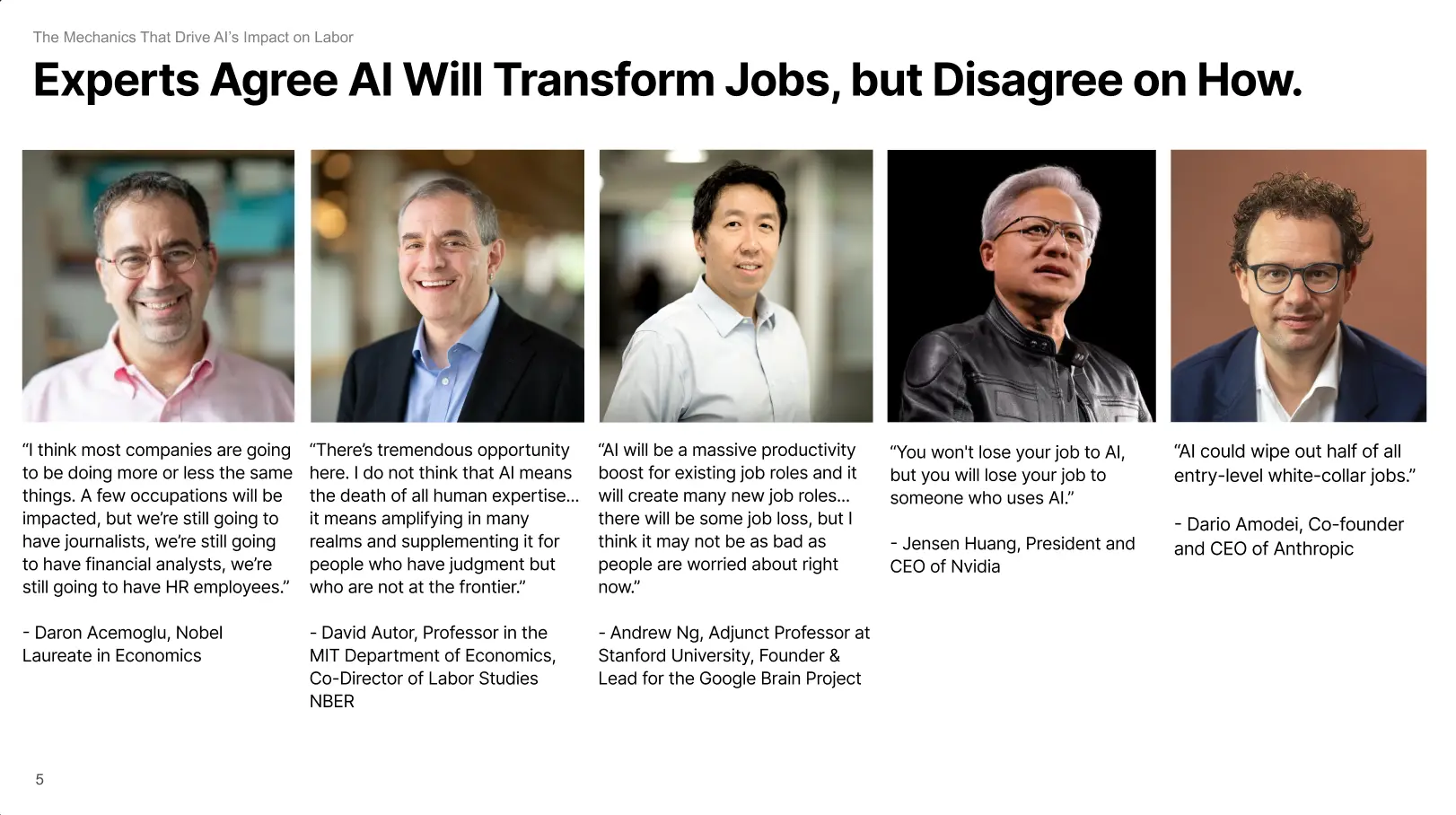 Source- https://chamath.substack.com/p/deep-dive-ai-effect-on-labor-market