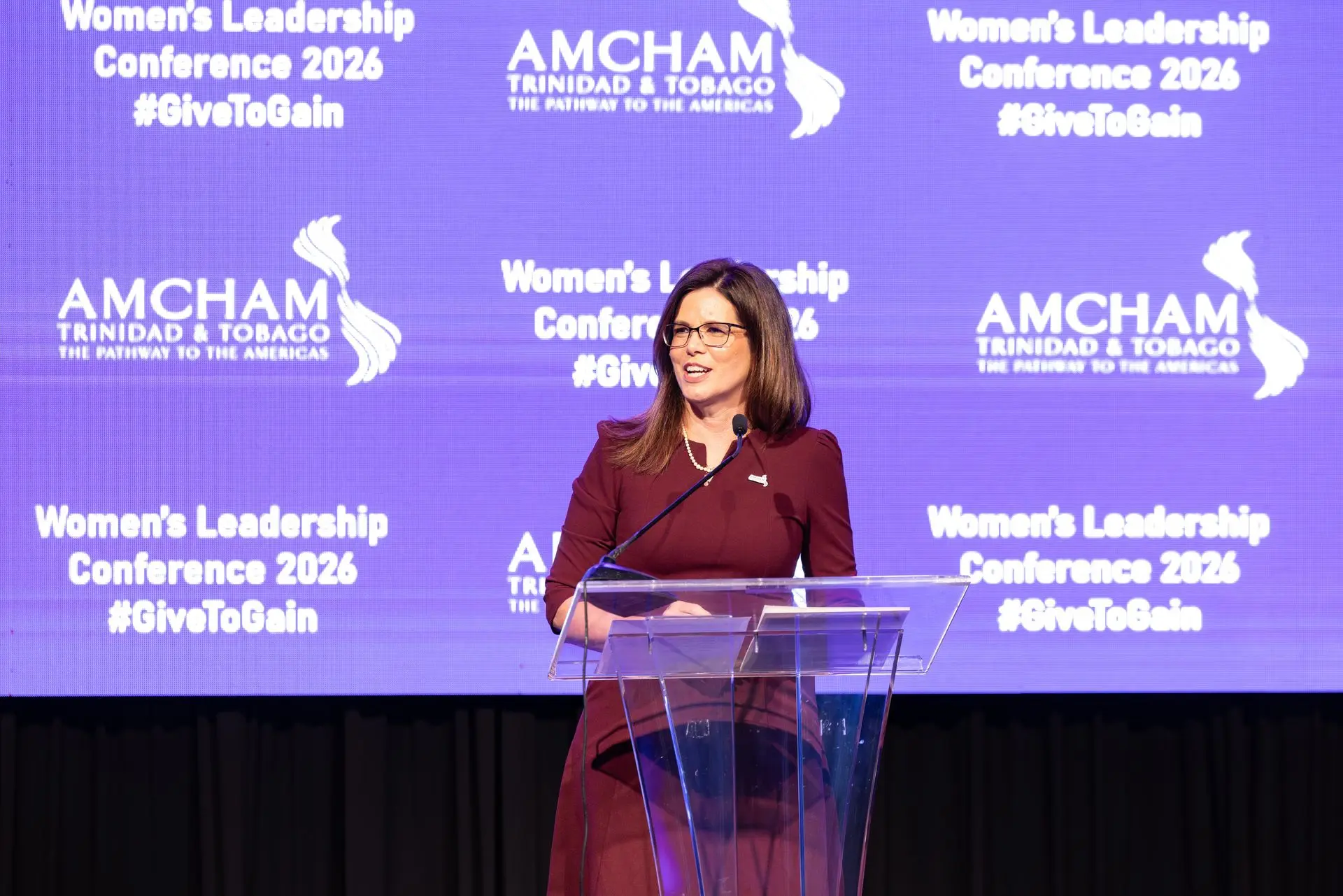
Good morning, everyone.
Distinguished guests, partners, members of AMCHAM T&T, colleagues, friends, and the extraordinary women and allies gathered here today — welcome to AMCHAM T&T’s 12th Annual Women’s Leadership Conference.
We host this conference each year for a very simple reason: because leadership matters — and because progress does not happen by accident.
Twelve years ago, this conference began as a conversation about possibility. Today, it has become a national platform for action, collaboration, and impact. Over the years, many inspiring and highly accomplished women leaders, professionals, entrepreneurs, change-makers and male allies have stood on this stage, sharing knowledge, challenging norms, and shaping the future of business and leadership in Trinidad and Tobago.
And the growth we celebrate here is reflected within AMCHAM T&T itself.
I stand before you as the fourth female President of this organisation — and notably, the third woman to serve as President within our last four leadership terms. This year, I am proud to say that AMCHAM T&T is led by three women at the helm — a female President and two female Vice Presidents.
That did not happen in part, by coincidence.
It happened because people before us chose to give opportunity, give trust, and give leadership space — and in doing so, the organisation gained strength, diversity of thought, and resilience.
That is the spirit of our theme this year: #GiveToGain.
It also happened because we were willing to step up. Too often, when presented with opportunities, women doubt themselves. Their capabilities. Their competence. Over-estimate risk. Generally, much more so than men. So, we hope that when we step up, we show others that they not only can, but should aspire to; should be intentional and that female ambition is not “pushiness” but is as natural as male ambition.
Investing in Women Is an Economic Strategy — Not a Social Favour
When we speak about advancing women, gender equity, or inclusion, the conversation is sometimes framed as a social obligation — something nice to do or morally correct to pursue.
But let us be clear: Investing in women is not charity. It is a sound economic strategy.
Women already play a vital role in our economy. And if we want national growth, competitiveness, and diversification, we must ensure women have the space, protections, rights, and opportunities not simply to participate — but to thrive.
And if we expect to grow and expand our economy, then we must be prepared to do more.
When we speak about economic diversification, enabling the digital economy, strengthening the blue and green economies, expanding entrepreneurship, and creating new revenue streams beyond traditional sectors, we cannot overlook the vital role women must play in that transformation.
Women already make up nearly half of the labour force in Trinidad and Tobago. They are strongly represented in sectors such as education, health and social services, retail and wholesale trade, financial services, and public administration. Girls are consistently outperforming boys academically at the secondary and tertiary levels. The talent pipeline is there.
Yet, when we look at senior executive leadership, boardrooms, and high-growth industries, the numbers narrow significantly. Fewer women occupy top decision-making roles. Women remain underrepresented in the energy sector — one of our most critical economic drivers — and even more so in technology, a sector experiencing explosive global growth and positioned to shape the future of work and national competitiveness.
This is not a talent issue. It is a structural issue.
If we are serious about national development, then women’s economic participation cannot be an afterthought. It must be embedded into our national planning and budgeting frameworks. That means designing policies that intentionally expand women’s access to capital, leadership opportunities, digital skills training, STEM pathways, and emerging industries. It means ensuring women are not only present in the economy, but positioned to influence, innovate, and lead within it.
Because future growth will not come from maintaining the status quo. It will come from unlocking the full capacity of our population.
Investing in women is not a social programme. It is a growth strategy. And if Trinidad and Tobago is to remain competitive, resilient, and forward-looking, women must be central to how we design the next phase of our economic development.
That is Give to Gain in action.
Mentorship — and Sponsorship — as a National Responsibility
One of the greatest drivers of advancement is mentorship.
Many women do not lack talent or qualification — they lack access, networks, advocacy, and visibility. Too often, opportunities are decided in rooms they were never invited into.
Mentorship helps women navigate systems, build confidence, and access institutional knowledge. But today, mentorship alone is not enough.
We must move toward sponsorship.
A mentor advises you.
A sponsor advocates for you when you are not in the room.
Sponsors recommend your name for leadership roles. They open doors. They attach their credibility to your potential.
This is where the private sector can lead.
If we are serious about leadership pipelines, companies must intentionally sponsor emerging female leaders — ensuring talent is not overlooked simply because access was unequal. We need more companies today to move beyond conversation and commit to actively opening doors, championing talent, and creating clear pathways for women to step into leadership and decision-making roles.
When leaders give advocacy, organisations gain stronger succession, innovation, and performance.
Boardroom Representation & Decision-Making Power
It’s why representation matters — not only as a symbol of progress, but as a driver of better decisions and stronger outcomes.
Inclusive leadership is not about replacing one group with another — it is about ensuring decisions reflect the realities of the workforce, the marketplace, and the society we serve.
Giving women access to decision-making power is not lowering standards. It is recognising excellence that already exists.
Because when companies give women a seat at the table, they gain smarter decisions — and a stronger future.
Why These Conversations Matter Now
That’s why after twelve years, this conference is no longer about proving that women belong.
That question has already been answered.
Today, we are addressing the conditions that determine how safely, confidently, and sustainably women can lead.
That is why this year’s agenda includes conversations around sexual harassment, and around money, marriage, and menopause – issues that impact women’s careers.
Because leadership does not exist in isolation from lived experience.
And culture begins earlier than we often realise. And men you have to be part of the solution. I have had some excellent male sponsors and allies. But I have also experienced many situations in which I felt like an outsider in the old boys’ club.
That’s why we must continue to shine a light on the fact that workplace culture matters. Financial security matters. Health matters.
The subtle messages that teach young girls to shrink, apologise, or doubt their worth.
Those moments accumulate — shaping classrooms, locker rooms, workplaces, and eventually boardrooms.
We must challenge those norms early so that future generations grow up knowing their value is unquestionable — so that we judge our leaders less by what they wear, and far more by how they lead.
Addressing these issues is not about criticism. It is about building healthier environments for everyone to succeed.
A Personal Truth About Giving
And if I may share something personal…
Every woman in this room today understands giving in ways that are rarely acknowledged.
We give to our children, often placing their needs ahead of our own ambitions.
We give to our relationships and families, often setting aside our own rest, time, and personal desires.
We give to our careers, often pushing beyond limits and proving ourselves again and again in pursuit of opportunity.
And sometimes, after giving so much, it feels uncomfortable to ask for anything in return.
Many women have been taught that ambition must be quiet… that wanting advancement, recognition, balance, or financial security somehow makes us ungrateful.
But it does not.
Women should never feel embarrassed or afraid to proudly state what they hope to gain from the sacrifices they make.
To want growth is valid.
To want leadership is valid.
To want opportunity, stability, fulfillment — is valid.
Giving should never require disappearing.
When women give, they are investing — and every investment deserves a return. So ladies, if you take away just one message from this conference, let it be this: never be afraid to speak up for what you know you deserve after you have given so much to so many. Ask for what you want. Of course, be strategic but do go for it. And if you hesitate, ask yourself, “would my male colleague hesitate like this?”
Closing
As I close, I want to say that over the past twelve years, this conference has evolved alongside the women it represents — confident, accomplished, solution-focused, and forward-looking.
Today, we celebrate how far we have come. But more importantly, we recommit to what comes next.
To giving mentorship/sponsorship and gaining leadership.
To giving opportunity and gaining innovation.
To giving courage and gaining transformation.
And most importantly — to creating a Trinidad and Tobago where every woman feels empowered not only to give… but to proudly claim what she deserves to gain.
Because #GiveToGain is more than a theme.
It is how we build stronger businesses.
It is how we develop stronger leaders.
It is how we secure the promise of a stronger and more united and equitable nation for all.
Thank you, and I wish you an inspiring and impactful conference.
END.