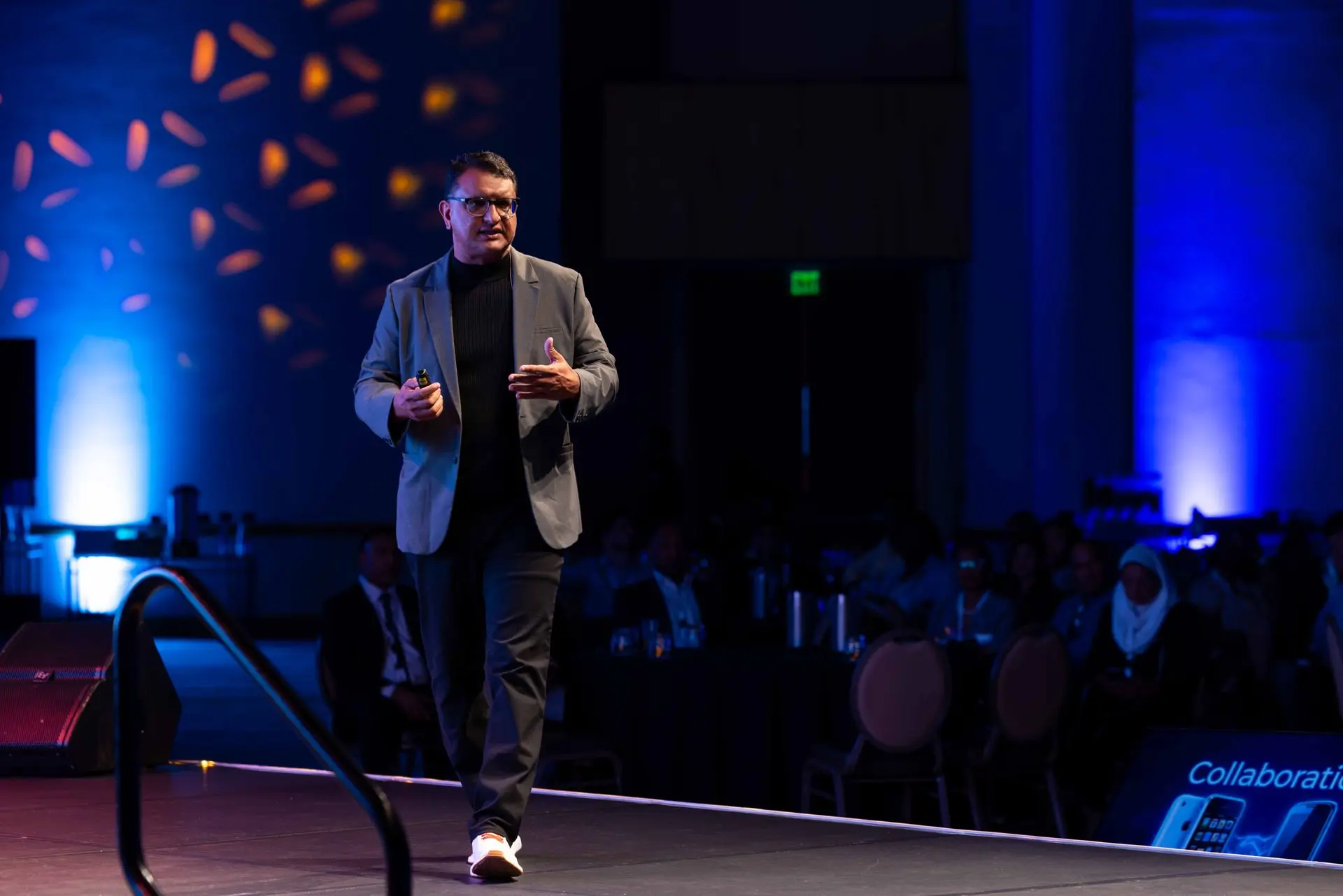
I am Nirad Tewarie, CEO of AMCHAM Trinidad and Tobago, and it's my honour to welcome you to the eighth edition of the Tech Hub Islands Summit.
The summit is hosted by AMCHAM Trinidad and Tobago in collaboration with Massy, and we are really, really excited about this event. We're excited about all our events, but especially this one because we believe it has the potential to be truly transformative.
Technology has a way of sometimes feeling disconnected from our everyday lives. We don't always connect with it beyond the devices we use. But today, we're here to explore how technology is transforming business, government and society.
We have a really exciting lineup this year. When AMCHAM Trinidad and Tobago launched this summit eight years ago, we had three main objectives, and they remain just as relevant today.
The first was to push and drive digital transformation in the private sector.
The second was to push, drive and collaborate with the public sector on digital transformation.
The third—and truthfully, where we may still be falling a little short—is to create the environment for a marketplace and a network between what we call the founders and the traditional private sector, so that we can create the conditions for market development in Trinidad and Tobago.
We've been working toward that because, at AMCHAM Trinidad and Tobago, we genuinely believe we can build a viable tech sector in this country.
Before I get into my remarks, though, I'd like to ask everyone, however you feel comfortable, to take a moment of solidarity with the families who have lost loved ones in our closest neighbour, Venezuela.
So, a moment of silence for all those who have lost their lives and loved ones.
Thank you.
The private sector in Trinidad and Tobago is working alongside the Government in support of Venezuela. We have circulated information about two main collection points—at the Piarco International Airport and at the Point Lisas Port—and we are also working amongst ourselves to see how we can leverage additional support.
We've already received offers of assistance from Amerijet. We're working with partners in the energy sector to determine how we can utilize transportation capacity into Venezuela as needed. We also have firm commitments from Massy and Liberty to help move relief supplies, and we're going to continue doing this for as long as it's needed because the reports coming out of Venezuela continue to be devastating.
SEWA TT will also be here later today. They are organizing relief buckets, and they'll be accepting small contributions which will then be packed and transported to Venezuela using either Government or private-sector logistics.
So, let's get into it.
I have the honour of delivering AMCHAM's opening remarks this morning.
I want to thank Anna and the Board for allowing me to do this.
Anna said something very endearing to me. She told me she understands why this event is so important to me, and not every organization does that. I genuinely believe the Board of AMCHAM T&T does things for the greater good and the greater benefit, and that's one of the reasons it is such an honour to be standing here today.
So thank you, Anna, for allowing me to do this.
As I said, we at AMCHAM T&T believe there is now an imperative for every company and every institution to see itself, at the very least, as part technology company or part technology institution.
Technology is no longer separate. It's no longer just a department. It's no longer "those people" who come when your computer freezes or your Windows crashes.
We have to see our businesses, our institutions and even the public sector as technology-enabled organizations.
That is what will allow us not just to survive, but to thrive. And because of that, we have to be ambitious.
Minister, I want to respectfully suggest that we set a national goal of ensuring that at least 7% of Trinidad and Tobago's GDP comes from the technology sector.
We can use current GDP as our baseline because, hopefully, GDP itself will continue to grow. The estimates I have seen suggest that technology currently contributes somewhere between 2.8% and 3.7% of GDP, with most estimates closer to 2.8%.
So let's develop a plan—or a series of interconnected plans—to increase that contribution to 7%.
You might say seven is a random number. I'm saying let's double it.
Minister, if you say six, we won't fight you—we'll work with you. If you say ten, even better. Because achieving that target wouldn't simply grow the technology sector itself.
The implementation and deployment of technology across every sector of society would generate productivity gains throughout the economy. It would improve not only our traditional oil, gas and petrochemical industries but also the non-energy sectors because they would become more efficient, more competitive and more outward-looking through technology.
The value of doubling the technology sector's contribution to GDP would ripple throughout the entire economy.
And that's how we need to see it.
When we look at sectors for diversification, I'm a strong supporter of the creative industries. I'm also a strong supporter of agriculture and tourism. We support all of those sectors.
But if we ask ourselves where we already have the human resource capacity to move quickly—where we can achieve medium-term growth—we believe technology is one of those sectors.
It can also become a major foreign exchange-earning sector, which, as we all know, is one of our country's biggest challenges today.
When people thought about the technology sector ten or twenty years ago, they tended to think of it as something concentrated in a few countries.
Today, we're beginning to understand where the different nodes of the global technology ecosystem exist.
Taiwan and semiconductors. Critical minerals. The Netherlands and the machinery required to manufacture chips.
So why can't Trinidad and Tobago become an important node within that global value chain?
Why not?
Minister, I know you'll probably touch on this later in your remarks, but if, in the near future, we have significantly more natural gas available than we currently consume, then we should already be planning for how some of that energy could support energy-intensive technology industries.
Today we may not have that opportunity. But two years from now, we might.
Data centres, for example, don't appear overnight. You have to attract investment, identify customers and determine the business case well before they're built.
If, as we expect, petroleum resources continue to be developed in and around Trinidad and Tobago, then we often speak about the Southern Caribbean becoming an important provider of energy security.
But what if we also developed a Southern Caribbean technology ecosystem—bringing together Trinidad and Tobago, Venezuela, Guyana and Suriname?
The world is increasingly looking toward South America for critical minerals and trying to diversify away from overdependence on one or two countries.
If we combine energy security, economic security and technology development—and place that in the context of today's geopolitical realities—we have an opportunity.
When we see what's happening around the world, including the conflict in the Middle East and its implications for global technology infrastructure, and when we consider the relative peace and stability of our region—we do, of course, have to consider tectonic risks—but we are below the hurricane belt, and we can build resilient infrastructure.
Why not build a Southern Caribbean technology cluster?
We would certainly welcome learning from places like Medellín and other successful innovation centres in Colombia.
But for all of this to happen, we must build trust.
When we engage with other AMCHAMs and global companies, one message consistently comes back to us.
We need to increase confidence in Trinidad and Tobago as an investment destination.
That means continuing work on our legislative environment and answering important questions around issues such as data sovereignty.
Minister, we're very pleased you're here today.
We know the Chair of iGovTT and members of the executive are also here, and we hope these conversations continue so that together we can find the right solutions.
Of course, one of the biggest questions surrounding technology is people.
What about jobs?
The outcomes vary. Some companies are creating more jobs. Others are redesigning existing roles. Regardless, every organization now has to rethink how work gets done.
We have to find the balance between upskilling our people and redesigning organizations for a technology-enabled future.
It's not easy. But it's something every company has to do.
Some companies, like Ramps, have already made significant progress.
So yes, we have big ambitions. But we also see several achievable first steps.
One of them—and Chargé, we're very happy you're here today—is digital nomad visas.
Minister, you and I were discussing this as soon as you arrived. Let's make this the year we finally establish that policy framework. Let's also start with Global Entry.
From what I understand, that begins with an MOU and then the development of a national verification framework.
As part of the Shield of the Americas, perhaps Trinidad and Tobago is well positioned to become part of the Global Entry programme.
Minister, together with your Cabinet colleagues, we also believe Trinidad and Tobago has the potential to become a U.S. pre-clearance port.
That would strengthen our position as a logistics hub.
The reason I mention this is to demonstrate that policies are interconnected. If we want to become a global technology hub, then we need connectivity. We need easier travel. We need the conditions that attract people and investment.
A pre-clearance facility would allow travellers to access U.S. airports that don't currently process immigration, opening entirely new markets and strengthening our competitiveness.
AMCHAM T&T also developed an Assurance Framework paper under the previous administration that received broad support. Minister, we'd welcome the opportunity to discuss that further. Perhaps a public-private task force could begin moving that work forward.
I believe the multilateral institutions would be eager to support such an initiative if Government and the private sector were aligned behind it.
As I close, let me share a simple story.
Remember when the first iPhones came out?
The App Store dominated. Then Android devices began gaining market share.
Part of the reason was simple. The Apple App Store was relatively closed. Android was far more open. Eventually, Apple also had to become more open.
The lesson is simple. Too often we try to do everything ourselves. Too often we don't collaborate. But none of us can do this alone.
Not Government. Not the private sector. Not Chambers of Commerce.
Once we agree on the key objectives, we have to create effective mechanisms for collaboration.
We've all heard the proverb: "If you want to walk fast, walk alone. If you want to walk far, walk together."
I think we can do both.
We can walk fast—and far—together.
That's why we're so pleased to have signed an MOU with the Artificial Intelligence and Innovation Centre. It won't be just another ceremonial agreement.
This month, supported by the UNDP, AMCHAM, the UNDP and the AIC will launch a programme offering up to ten medium-sized companies the opportunity to develop AI deployment plans.
We will assess participating companies and identify practical AI tools they can implement. In fact, AMCHAM itself has volunteered to participate because we recognize that we also need to transform.
We're also in discussions with a major corporate organization that will work through the AIC to develop bespoke AI solutions locally instead of sourcing them externally.
That creates capacity. It develops the market. It strengthens local expertise. And hopefully delivers better solutions at competitive costs.
That's the kind of collaboration we're trying to foster.
I'll tell you something.
For the first time in the eight years we've been hosting this summit, I genuinely feel we've made real progress.
Our first session, From Hype to Impact, will explore how organizations are moving beyond conversation to implementation.
We'll then discuss cyber resilience, risk transfer and insurance as part of a broader conversation about trust.
We'll hear from founders who are building companies in Trinidad and Tobago and selling their products to the world.
We often imagine founders as teenagers in hoodies. Ours are a little older—our Not-so-Young Turks.
We'll also explore DPI for ROI—how Digital Public Infrastructure delivers value for both Government and business. That panel brings together representatives from the public and private sectors, including the Chair of iGovTT and the official leading the modernization of ASYCUDA to move Customs toward a fully digital, paperless future.
We'll also examine FinTech, with the Governor of the Central Bank leading discussions on regulation and the future of financial innovation. We believe FinTech is one of Trinidad and Tobago's greatest opportunities. We already have the largest financial services sector in the English-speaking Caribbean. It makes sense for us to build on that strength.
Our session Together We Achieve focuses on people—how organizations manage culture, talent and workforce transformation in the age of AI.
Finally, Talk to Me explores the practical implementation of AI and large language models. We'll hear directly from Ramps Logistics, a company that has successfully developed technology products while transforming its own operations through AI and digital innovation. Their story demonstrates what's possible and offers practical lessons other companies can take away.
So, we really hope you enjoy the next two days with us. And we hope you continue working with AMCHAM T&T to create that ecosystem to allow for the development of a local tech sector and the doubling of the tech sector contribution to GDP in Trinidad and Tobago in the coming years.
Thank you very much.