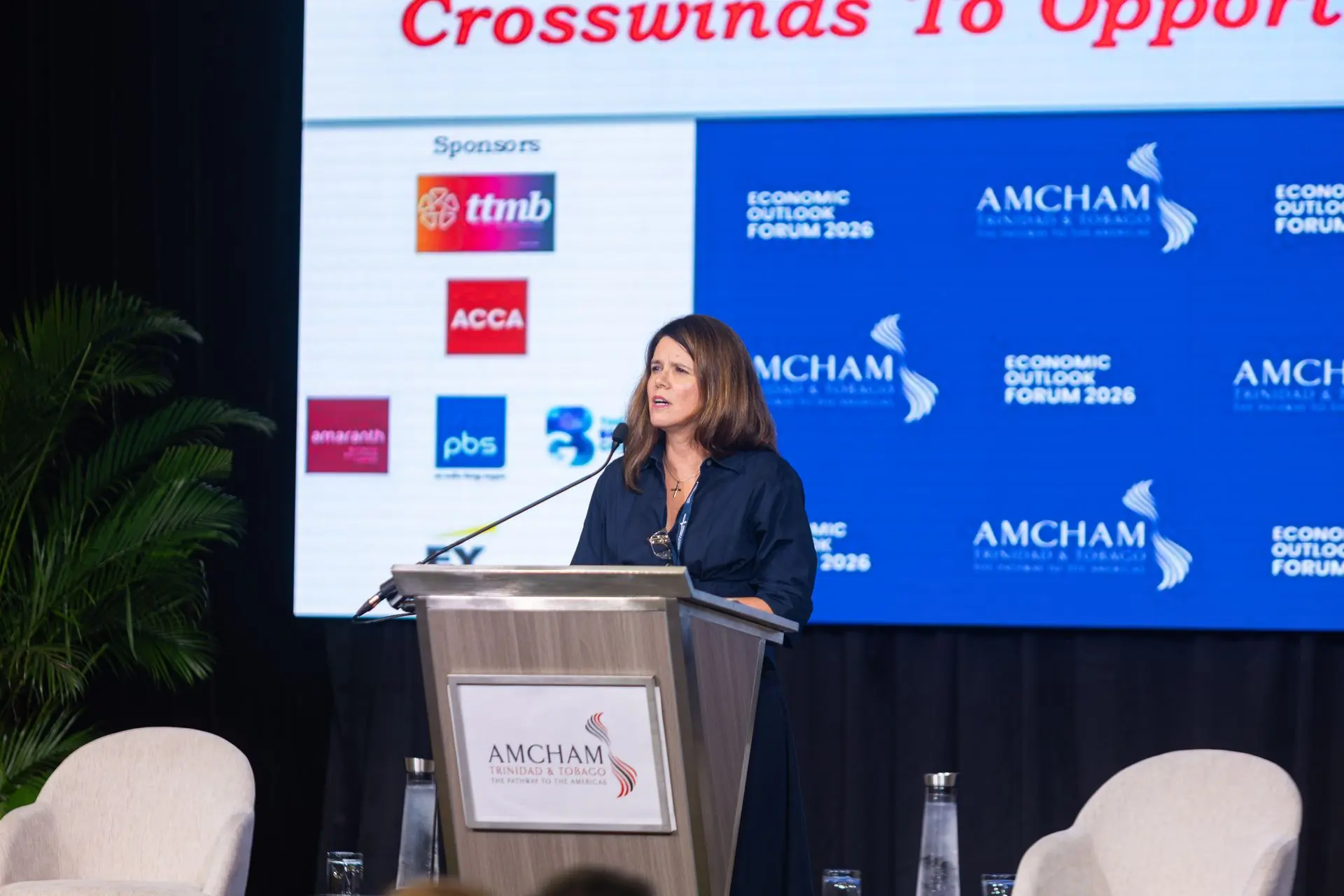
THEME: Crosswinds to Opportunities
Good morning, everyone.
Thank you for joining us here at our Annual Economic Outlook Forum – our first major event for 2026.
At AMCHAM T&T, we have never positioned ourselves as an organization that complains about conditions. Instead, we position ourselves to build within them and to seek opportunities.
And that is why this year’s theme, “Crosswinds to Opportunities,” is not simply descriptive. It is intentional.
Because the truth is, Trinidad and Tobago is not navigating these currents alone.
The entire global system is in motion.
In recent years, our economic growth has remained constrained. International institutions project that real GDP growth ended 2025 at approximately 1 percent and is expected to remain modest in 2026, reflecting limited momentum outside the energy sector and persistent structural challenges. At the same time, public debt is projected to remain elevated – near 69 to 70 percent of GDP – continuing to restrict fiscal flexibility and large-scale transformative investment.
These indicators do not point to crisis – but they do signal urgency.
They tell us that maintaining the status quo will not deliver the level of growth, diversification, job creation, or resilience our economy requires. And yet, even as these realities confront us, something else must also be acknowledged.
We are living through a period of profound global transformation.
The Fourth Industrial Revolution is no longer emerging – it is here.
Artificial intelligence, automation, digital platforms, advanced manufacturing, and data-driven systems are reshaping business models, redefining competitiveness, reordering geopolitics, and transforming how societies function.
We see it everywhere: in restructured global supply chains; in nearshoring and reshoring strategies; in digital economies that scale without borders; and in new forms of conflict, commerce, and cooperation.
This tells us what we have always known: Change is no longer cyclical. Instead, rapid change is now the norm.
In moments like this, it is easy to become distracted by noise – to be drawn into short-term thinking, and feelings of uncertainty and frustration.
But everyone here knows that business does not succeed on distraction.
As a business chamber, our role is to do what business has always done best: to assess reality clearly, to anticipate what is coming, and to create environments where we can succeed – today, tomorrow, and in the future.
And it is precisely within this context that Trinidad and Tobago must locate itself.
There is no denying that the past decade has been difficult. Economic conditions have tightened. Costs have risen. Global shocks and domestic constraints have made operating environments more complex.
But we are also beginning to see signals that movement is possible.
Crime trends are showing early signs of improvement.
Institutional reform efforts are underway, including renewed momentum in customs modernization. (We are grateful to the Comptroller of Customs for the constructive engagement and continued collaboration in advancing this effort.)
Government is showing visible intent to address long-standing structural inefficiencies that affect trade, investment, and productivity.
These are not minor developments. They are foundational.
Because crime, border management, infrastructure, and institutional effectiveness are not social footnotes. They are economic imperatives.
That is why we are especially pleased that Minister Jearlean John is with us today, as Government embarks on a high-stakes revitalization effort aimed at modernizing infrastructure, improving systems, and repositioning the economy.
We believe that if these policies and reforms are implemented decisively, they hold real potential to unlock new sectors, diversify growth, and strengthen the business climate.
Listen, we know this work will be complex. We know the financing will require innovation. And yes, it’s also no secret that the coordination will be demanding.
But nations do not wait for every light to turn green before they move forward.
They move when the destination matters.
They move because the future is worth building.
That’s why this transformation cannot be government-driven alone.
If this vision is to move from strategy to outcomes, the private sector must engage not as observers, but as co-architects.
At the same time, there are external developments that give us grounds for cautious, strategic optimism.
In recent months, we have seen renewed activity by Exxon, alongside emerging discussions around collaboration with Venezuela. These developments hold the potential to stabilize our gas supply in the near to medium term – an outcome that could rebalance our energy sector and create space for broader economic transformation.
But energy must become more than a revenue stream. It must become a platform.
A platform to build new industries.
A platform to deepen competitiveness.
A platform to drive diversification.
And that is where opportunity comes into focus.
We see opportunity in the maritime and ship-repair industries, where our geography, port potential, and technical capability position Trinidad and Tobago to emerge as a serious southern Caribbean hub.
We see opportunity in tourism – not only leisure tourism, but conferencing, medical tourism, sport, culture, and experience-based travel.
We see opportunity in logistics and transshipment, leveraging our proximity to South America and our location along major global shipping lanes.
We see opportunity in advanced services, digital industries, and nearshoring – creating high-value jobs, modern enterprises, and pathways for our talent to remain globally connected.
This is where Trinidad and Tobago hold advantages that are structural, not speculative.
We are outside the hurricane belt.
We sit at the gateway to South America.
We possess deep industrial capability.
We have a skilled, adaptable workforce.
We maintain access to critical regional and international markets.
These are not theoretical strengths. They are commercial opportunities – if we organize ourselves to pursue them.
And that brings us back to the heart of today’s theme: “Crosswinds to Opportunities” is not just a slogan. It is a strategy.
It means imagining an economy where public and private capital mobilize together to modernize infrastructure, expand industries, and crowd in global investment.
Where Trinidad and Tobago position itself as a serious southern Caribbean hub for logistics, maritime services, and innovation.
Where artificial intelligence and digital platforms are used to modernize public services, raise productivity, and build globally competitive firms.
These outcomes are attainable.
But only if we commit ourselves to open communication, deeper collaboration, greater transparency, a shared national vision, and an unwavering respect for the rule of law.
So let us work together — not to return to the past, but to build a bold future where equity guides us, safety anchors us, sustainability shapes us, and collaboration drives national progress.
(EY Survey + Closing)
As I close, we look forward to hearing the insights from our survey conducted with our partners at. The results of this survey are a reflection of your experiences, your concerns, and your expectations. It is your voices that ground these conversations in reality, and they must continue to inform the strategies we pursue.
Let us remember: the measure of this forum will not be what is said here today, but what is built after it.
May this gathering strengthen trust.
May it deepen partnerships.
And may it remind us that while the crosswinds are real, so too is our capacity to rise into them — and to chart a future worthy of the people of Trinidad and Tobago.
Thank you.
END.