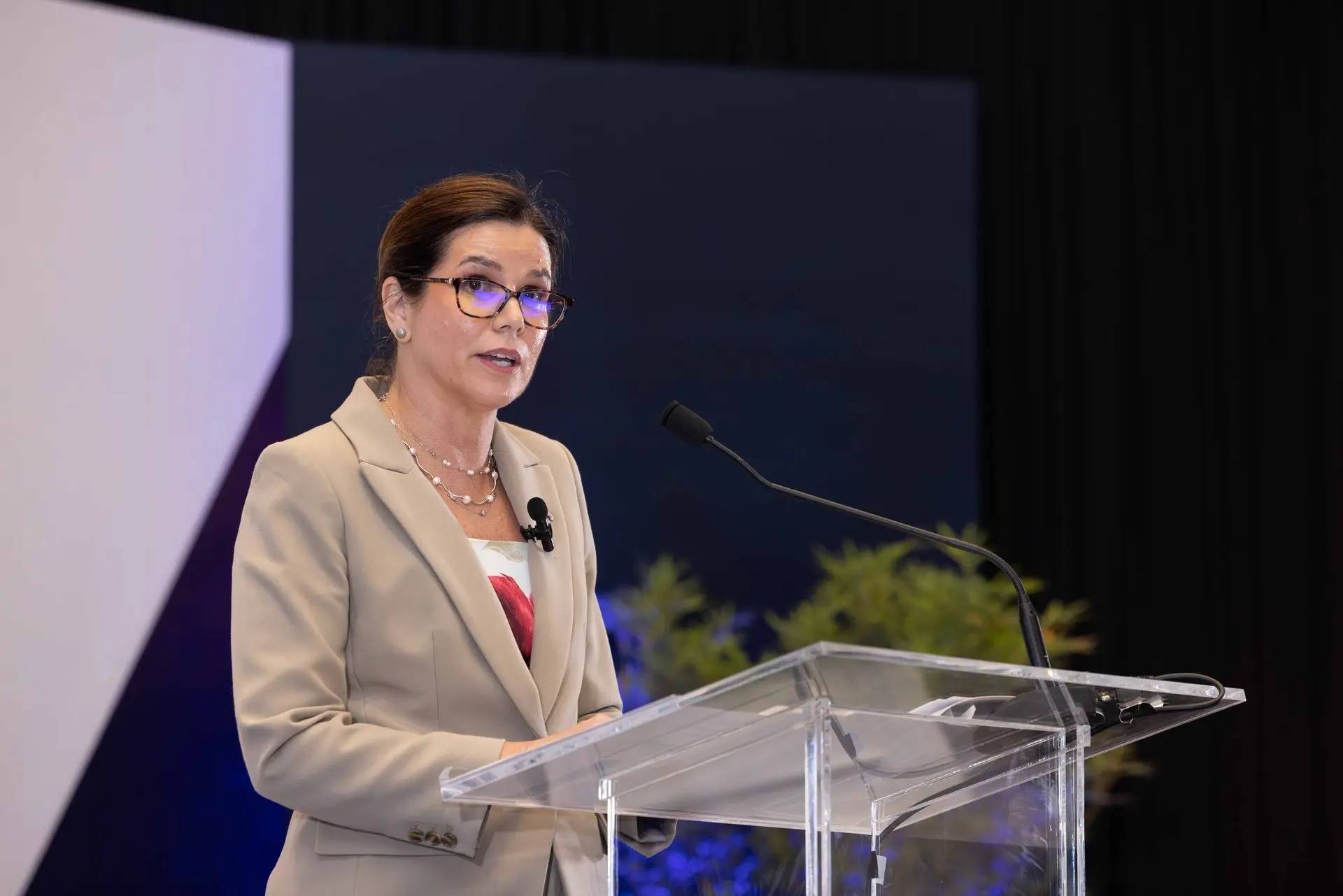
Good afternoon, everyone.
It is my esteemed pleasure to welcome you to our 33rd Annual General Meeting & Business Forum.
On behalf of the Board of Directors and CEO of AMCHAM T&T, thank you for your continued support and collaboration. I am honoured to once again serve as President and look forward to working with our new Board on your behalf.
As I reflected on today’s message, I found myself thinking both about where we want to go and where we find ourselves today as a nation.
In many ways, that reflection speaks directly to the theme of this year's Business Forum: Now to Next. It is a simple yet important question: How do we move from where we are today to where we need to be tomorrow?
Consider that 52% of the companies that were listed on the Fortune 500 in 2003 have since gone bankrupt, been acquired, or otherwise ceased to exist. And that 45% of respondents in PwC’s most recent Global CEO Survey said their company won’t be viable in ten years if it sticks to its current path.
Add to that, a wave of generational changes in SMEs in particular.
We are already seeing the signals of change all around us.
In our membership trends over the past several years—we’ve seen consolidation, the exit of founders, new technologies reshaping how value is created, and shifts in how customers consume products and services. We’ve seen businesses searching for new markets to survive and grow. And yes, we’ve seen closures—some driven by economic pressures, others by deeper inefficiencies in our system.
Delayed state payments and limited access to foreign exchange. The rising cost—both financial and human—of crime. And institutional weaknesses that create uncertainty and opacity in how business is conducted.
Families are struggling with the rising cost of living. Young people are questioning where opportunity exists for them. Communities remain concerned about crime and safety.
But beyond the numbers and headlines, there is something deeper taking place. It is this overwhelming feeling that progress is becoming harder to see.
We see it in the violence reported in our schools. The loss of confidence many citizens feel toward institutions meant to protect and serve them. And it is reflected in the anger, distrust, and division that increasingly shape national conversations on almost every issue.
Now, none of these issues exist in isolation.
Crime is not disconnected from economic insecurity. Distrust is not disconnected from leadership. And social frustration is not disconnected from opportunity.
At the heart of it, people want to feel that the systems around them are still working, that leadership still carries credibility, and that effort and hard work can still lead to opportunity and progress.
This is our NOW.
Now, we often speak about diversification – as though it is something that can happen quickly. But the reality is more complex. For the foreseeable future, our energy sector will remain the backbone of our economy. And, as we have heard, there is a very real possibility of increased gas supply over the next three years. Therefore, we have a critical window of opportunity.
But opportunity alone is not enough.
We must act now to convert possibility into certainty.
That means creating the conditions that make investment viable.
That means ensuring there is a reliable market for that gas.
That means working collaboratively – across borders if necessary – to ensure that upstream producers, LNG operators, downstream industries, and participating countries all benefit.
Because if we get this right, the entire ecosystem wins.
But if we get it wrong – if we focus only on short-term gains, if we erode trust, if we destabilize the market – we risk undermining the very foundation of future growth.
This is not a moment for narrow thinking.
It is a moment for balance.
For shared responsibility.
For a willingness to give and take in the interest of long-term national prosperity.
And even when – because we must say when, not if – we return to a position of adequate or even abundant gas supply, that alone will not define our future.
Because NEXT is not just about restoring what we had.
It is about building what we do not yet have.
It is about diversifying deliberately, investing in new industries, and reimagining what Trinidad and Tobago can be in a changing global economy.
But rebuilding confidence requires honesty. Not public relations. Not carefully crafted narratives. Honest conversations about where we are, what is working, what is not, and what must change.
Trust cannot exist without transparency. And confidence cannot grow where accountability is absent.
This is where we, as a business community, can demonstrate leadership where others may fall short.
If we want citizens to believe in institutions again, then institutions must demonstrate that they are worthy of belief.
If we want businesses to invest confidently, then policy environments must be stable, transparent, and efficient. We cannot use ad hominem attacks on large segments of our society – whether they be based on creed, geography or class – if we want everyone to row in the same direction toward that more prosperous future for a revitalised T&T.
If we want young people to feel hopeful about the future, then they must see opportunities that feel real and accessible. We must ensure that law enforcement knows that the society supports them while simultaneously fostering confidence in all parts of the justice system.
And yes, let me be absolutely clear, that includes going after white collar crime. A few high profile, successful prosecutions of white-collar criminals will engender greater trust in the system.
In preparing for this speech, I went back to our AMCHAM T&T archives. As far back as February 2014, we held a breakfast meeting titled, “Tackling the Scourge of White-Collar Crime —Towards a Prosperous TT,” right here at the Hilton. Over the years, we made proposals to strengthen the FIU, implement Public Procurement Legislation, improve the criminal justice system.
Again, we urge the Government to ensure that the DPP’s office is fully staffed as a critical and necessary step to be able to have a properly functioning criminal justice system in which justice is delivered on time and fairly. As recently as April 30th this year, the Director of Public Prosecution is quoted in the media as complaining that his office “is, and has for some time, been operating under acute prosecutorial staff ¬deficits”. The Government must work with the Judicial and Legal Services Commission to address this expeditiously.
We do not all have to agree on everything. But surely, we can agree on this: we all want a safer country, a stronger economy, and a society where people feel they have a fair opportunity to succeed and move forward.
Our economy itself reflects this period of transition.
We have seen positive efforts by our government aimed at strengthening investment promotion, modernizing trade facilitation systems, and advancing digital transformation initiatives. And recently, we welcomed T&T’s election to the UN Security Council, a testament to the strength of our diplomacy and global reputation. These are important steps in the right direction.
We commend the Ministry of Trade, Investment and Tourism for its recently held one-year in office update inclusive of both the publication of targets and the progress being made to achieve those targets. While no plan will find favour with everyone, such actions do boost confidence, create a better understanding of what is being done, and increase transparency, and therefore trust in the Government.
We are encouraged and excited by the revitalisation plan. We know Minister John indicated some projects will begin by August, so we look forward to seeing these start to take shape.
The implementation of the Sail Clear system in a relatively short space of time, shows what’s possible with some will. So are the online immigration forms.
Let’s move on to some additional things, we encourage the Government to begin the process of securing the Global Entry option for travel to and from the U.S. and then, working toward making Piarco International Airport a pre-clearance port.
As the nature of work continues to change, let’s implement a digital nomad visa in T&T to encourage gig workers and founders to see T&T as viable place from which to work, while playing.
So now, the challenge is not one of ideas. It is, and probably always has been, a challenge of implementation. We must ensure that implementation keeps pace with ambition and that reforms translate into measurable improvements for businesses and citizens alike.
And this brings us back to the question before us today.
How do we move from Now to Next?
The pace of global change is accelerating. Countries that succeed over the next decade will not necessarily be the largest or the wealthiest. They will be the ones that can adapt quickly, invest wisely, embrace innovation, and build institutions that inspire confidence.
That is why AMCHAM T&T remains committed to investing in our people, supporting innovation, strengthening public-private collaboration, and advocating for the conditions necessary for sustainable economic growth.
Because sustainable growth cannot be driven by public expenditure alone. It must be supported by private sector investment, increased productivity, innovation, and an environment that gives businesses the confidence to expand, create jobs, and pursue new opportunities.
That is the journey from now to next. And it is a journey that requires all of us working together.
DIVERSIFICATION & INNOVATION
The task ahead is clear: we must build an ecosystem where new sectors can scale, attract investment, and drive real growth and jobs.
And one of our greatest opportunities lies in technology and the digital economy.
That is why initiatives like the Tech Hub Islands Summit—T.H.I.S.—matter. Because technology is not the future—it is shaping our competitiveness right now.
The opportunities are already in front of us: artificial intelligence, cybersecurity, fintech, automation, and digital transformation.
Countries that act will lead. Those that hesitate will fall behind.
This is why AMCHAM T&T continues to push for stronger digital infrastructure, innovation ecosystems, and talent development—through partnerships like our collaboration with the UWI Artificial Intelligence Innovation Centre.
Because moving to NEXT will not depend on resources alone, it will depend on our ability to innovate, adapt, and unlock the full potential of our people.
EASE OF DOING BUSINESS
At the same time, we must address longstanding structural issues that continue to impact competitiveness and business confidence.
Recent modernization efforts within Customs and Excise, digital government services, and investment facilitation initiatives implemented by the government represent important progress. However, competitiveness is ultimately measured by outcomes, and businesses continue to look for greater speed, predictability, and consistency across the operating environment.
In today's global economy, countries are competing aggressively for investment and opportunity. If we want to position Trinidad and Tobago as a competitive business destination, modernization and reform must continue to be major priorities.
CRIME, SECURITY & RESILIENCE
Another major concern remains security and resilience.
Crime is more than a social issue. It is an economic issue. It influences investment decisions, increases operating costs, impacts workforce wellbeing, and ultimately affects perceptions of national competitiveness.
Addressing crime requires not only enforcement, but sustained collaboration among government, business, communities, and civil society.
And increasingly, resilience must go beyond physical security alone.
Businesses now face cyber threats, climate risks, operational disruptions, supply chain vulnerabilities, and evolving global uncertainties that require entirely new approaches to preparedness and collaboration.
AMCHAM T&T continues to prioritize conversations around business continuity, resilience, HSSE excellence, and public-private collaboration.
GEOPOLITICAL PARTNERSHIPS
Which brings me to another important point – the importance of regional relationships.
In an increasingly interconnected world, no country grows in isolation, and strong commercial relationships and open dialogue will continue to play an important role in future economic growth and stability.
At a time when global trade patterns are shifting and supply chains are becoming increasingly regionalized, strengthening commercial relationships within our hemisphere presents opportunities that should not be overlooked.
That is why we are pleased to welcome Mr. Amaru Liendo, President of VenAmCham and General Manager of SC Johnson Venezuela & the Andean Region, as today's keynote speaker.
His participation comes at an especially important time.
As Trinidad and Tobago's closest neighbour, Venezuela remains strategically significant in areas such as trade, logistics, energy, manufacturing, and future commercial opportunities
We hope today’s forum provides fresh perspectives on regional opportunities and encourages new conversations around trade, investment, and collaboration. While there may be moments of tension and differing views, we must not allow short-term disagreements to distract us from the long-term progress our people deserve. There are more than enough opportunity, potential, and energy within this region to create shared success for all.
CONCLUSION
Ladies and gentlemen,
While we should not underestimate the challenges ahead, Trinidad and Tobago still possesses many of the ingredients needed for long-term success – talented people, a strong entrepreneurial spirit, strategic geographic positioning, and businesses that continue to adapt despite increasingly difficult conditions.
Periods of transition can either weaken confidence or inspire transformation.
I believe Trinidad and Tobago still has every opportunity to build a stronger, more innovative, more competitive, and more resilient future.
But doing so will require leadership grounded in integrity, institutions people can trust, multi-stakeholder collaboration and a collective willingness to believe again in what this country can become.
To our members, thank you for your continued support, partnership, and confidence in AMCHAM T&T.
Your commitment strengthens and reinforces why AMCHAM remains the preferred business chamber in Trinidad and Tobago – a chamber committed not only to advocacy, but to leadership, innovation, dialogue, collaboration, and national development.
Together, let us continue working toward a future defined not by fear or division – but by opportunity, resilience, innovation, and hope.
Thank you.