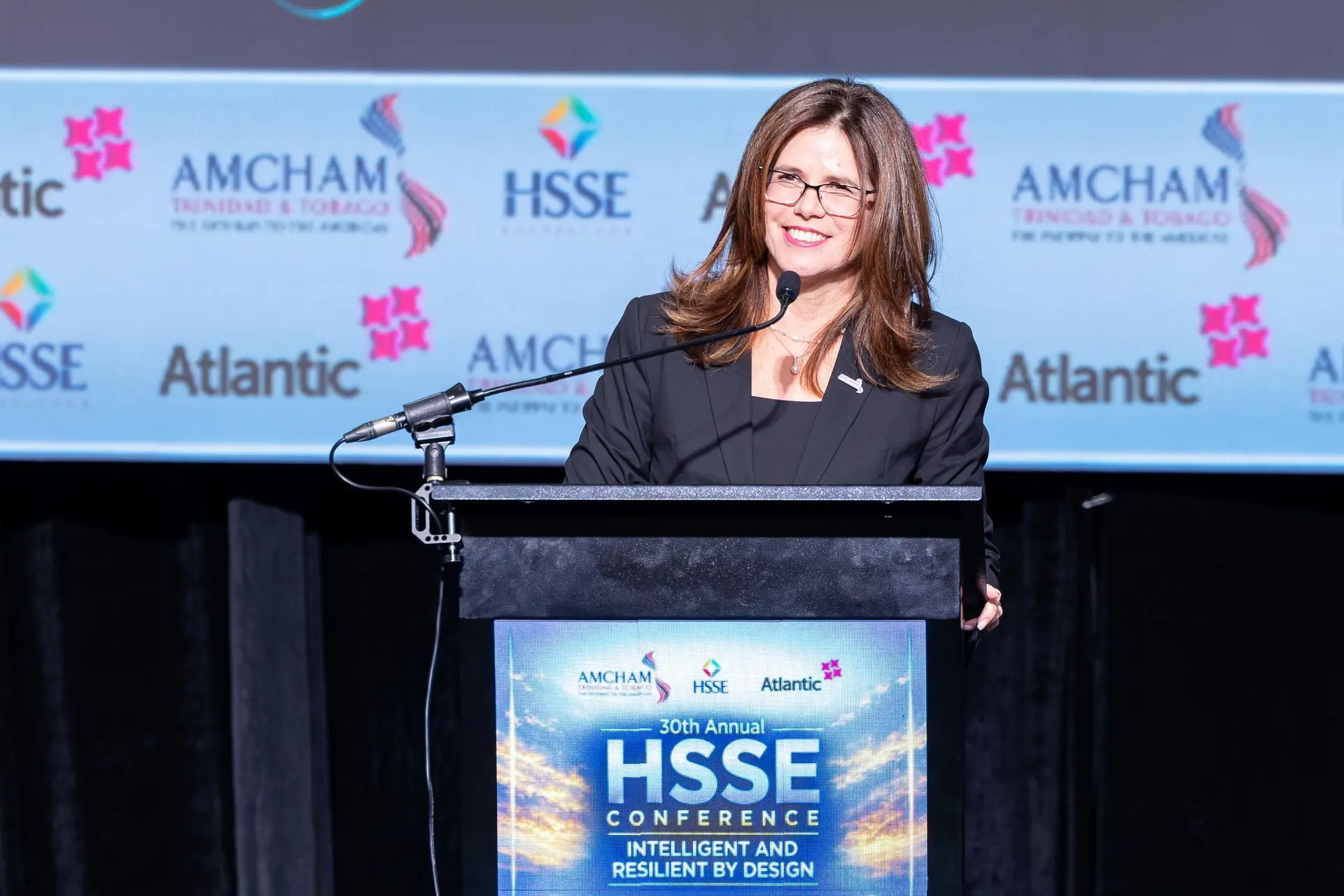
Good morning, everyone.
It is my pleasure to welcome you to our 30th Annual Health, Safety, Security and Environment Conference.
Thirty years is a significant milestone.
Let me take a moment to acknowledge the tremendous support we have received over the past three decades from our sponsors, partners, and loyal members of AMCHAM T&T. You have helped us build this conference into a platform for leadership, learning, and HSSE excellence, and we thank you for proving that “HSSE policies don’t just make good business sense, they also save lives”.
As we mark this milestone, I think it is fitting that our theme is “Intelligent and Resilient by Design.” Because the world in which we do business today is very different from the world in which this conference began.
Today, some of the greatest threats to business performance and resilience emerge outside our immediate field of vision. A cyberattack can halt operations in a matter of hours. A disruption deep within a supply chain can quickly impact customers, employees, and critical services. An environmental incident can escalate into a business continuity challenge with significant community consequences. And a security event beyond our gates can affect how people travel to work, how safe they feel, and ultimately, how confidently an organisation can operate.
In an increasingly interconnected world, events that appear isolated rarely remain so. Risks move faster, impacts travel further, and issues in one area can rapidly create consequences across the entire enterprise.
That is why intelligence matters.
It enables organisations to see beyond what is happening today, understand what may happen next, and make informed decisions before issues become crises.
It is not simply about having more information or adopting the latest technology. It is about recognising the warning signs, looking at the trends, and having the judgement, foresight to act before a problem becomes a crisis.
Technology can certainly help us do that. Artificial intelligence, data analytics, automation, and digital monitoring are changing the way businesses identify risk and make decisions.
But as our businesses become more connected, so do the consequences when something goes wrong. Cybersecurity, for example, cannot simply be left to the IT department. When a system goes down, the operations people have to deal with the consequences. The question is not only whether we can protect the technology, but whether our organisations are prepared for what happens when that technology fails.
And then there is the most important part of any organisation: our people.
This is where I believe the conversation about resilience becomes particularly important. We often talk about resilience as though it means being able to take on more, work longer, adapt faster, and keep going no matter what is happening around us.
But there is a point at which asking people to simply “be more resilient” misses the real issue.
People are tired.
As our way of life continues to evolve, our employees are not leaving everything else at the door when they come to work. Did we ever do this? Our people/ teams are dealing with the pressures of everyday life – family responsibilities, financial concerns, uncertainty, security concerns, and the demands of a workplace that is itself changing rapidly.
For many people, the line between work and life has become increasingly difficult to draw. Therefore, we should not be surprised when our people become exhausted, disengaged or simply reach a point where they have nothing more to give.
That is why burnout is a wellness issue. And an HSSE issue.
It affects how people think, how they make decisions, how they communicate, and how they respond when something unexpected happens.
An exhausted employee may be less likely to speak up about a hazard. A leader operating under constant pressure may miss something that they would normally catch. A team that has been stretched for too long may stop asking questions because everyone is simply trying to get through the day.
And that has consequences for safety, productivity, and the resilience of the organisation.
This is why I am particularly pleased to welcome our Featured Speaker, Paula Davis.
Paula's work asks us to look beyond the usual conversation about burnout. Rather than simply telling individuals how to cope with more pressure, she challenges leaders to consider the environments in which people are working and the systems that are contributing to that pressure.
Because if we want healthier and more resilient organisations, we have to ask ourselves a difficult question: Are we building workplaces that help people perform at their best, or are we building workplaces that continually ask people to operate beyond their limits without making room for the human?
That question is particularly relevant at a time when Trinidad and Tobago is also having a national conversation about productivity.
We all want businesses and state agencies to become more productive. We all want better performance, stronger enterprises, better jobs, and a more competitive economy.
But productivity cannot simply mean asking the same people to do more work, faster, with fewer resources and greater pressure.
If we want sustainable productivity, we have to pay attention to the conditions in which people work.
We also must ensure that leaders are equipped with the right tools to make decisions that protect both the wellbeing of their people and the performance of the organisation.
I know this is easier said than done, but that is why the conversation around burnout belongs at an HSSE conference.
A resilient organisation is not one where everyone is expected to absorb unlimited pressure. It is one where people feel supported, where they can raise concerns without fear, where leaders pay attention to what is happening within their teams, and where the systems around them allow them to do their jobs well.
This brings us to another important reality in Trinidad and Tobago: security.
Crime does not stop at the workplace gate.
It affects how people travel to and from work. It affects how employees feel about their safety. It affects businesses that operate late, businesses with mobile employees, businesses that handle cash or valuable goods, and organisations whose people have to move between locations.
Our businesses cannot solve the country's crime problem on their own. But we do have a responsibility to understand how the environment around us affects our people and to make sure our organisations are prepared.
The same is true of our changing environmental conditions.
We are already experiencing hotter conditions, and the Trinidad and Tobago Meteorological Service is warning of above-average temperatures and additional hot spells this month.
For someone working outdoors, in a plant, on a construction site, or in another demanding environment, heat is not an abstract climate issue. It is something they feel on their body while trying to do their job.
When we talk about environmental resilience, therefore, we have to bring the conversation back to people. How do we keep people safe when conditions change? How do we prepare for disruptions? How do we make sure our emergency plans work when we actually need them? How do we empower our managers to make different decisions aligned to their people and not the systems?
These are practical questions, and they are becoming increasingly important.
The same principle applies to cybersecurity.
Our digital systems are now part of the way we work every day, and the risks are evolving just as quickly. Trinidad and Tobago's Cyber Security Incident Response Team continues to issue warnings about serious vulnerabilities and active exploitation.
But behind every system is a person. Someone has to make the decision. Someone has to recognise that something does not look right. Someone has to know when to stop, when to report, and when to ask for help.
That brings us back to leadership, culture, and the human side of HSSE.
Because a strong safety culture is not created by a policy sitting in a binder.
If an employee sees a hazard but is afraid to report it, we have a problem.
If a near miss is something people would rather hide than discuss, we have a problem.
And if employees are so overwhelmed that they no longer feel they have the time or energy to speak up, we have an even bigger problem.
A culture of safety cannot exist where people are afraid to tell the truth.
This is also why I am pleased that we will hear from Niel Harper on Day Two, whose expertise in cybersecurity, digital trust, governance and enterprise risk will help us examine another side of organisational resilience.
Because you would agree, we cannot continue to manage safety, security, technology, people and business continuity as completely separate conversations when the risks themselves are increasingly connected.
A technology failure can become an operational problem. A security concern can affect our people. A poorly managed workload can affect decision-making. And a failure to listen to employees can allow a small problem to become something much bigger.
That is what makes the words “by design” in our theme so important. Good HSSE should not be something we add after the business has already been designed.
It should be part of the design from the beginning.
It should influence how we build our workplaces, how we use technology, how we manage risk, how we prepare for disruption and, perhaps most importantly, how we lead people.
As Trinidad and Tobago looks toward the next chapter of its economy, this matters even more.
We want to attract investment. We want to grow new industries. We want businesses to be competitive and productive. We want to diversify our economy while continuing to strengthen the sectors that have traditionally supported us.
But world-class HSSE cannot simply be something we talk about when an investor asks about our standards. It has to be part of how we do business.
A country that can demonstrate strong safety systems, responsible environmental practices, effective governance, and resilient organisations is a country that inspires confidence.
And confidence matters.
So, as we celebrate thirty years of this conference, we should be proud of how far the conversation has come. But we should also recognise that the next thirty years will demand even more from us.
The question is no longer simply whether we have a safety policy. It is whether that policy is reflected in the way we actually work.
It is not simply whether we have an emergency plan. It is whether our people know what to do when the emergency happens.
And it is not simply whether we have resilient employees. It is whether we are building organisations that do not continually push those employees to their limits.
Thirty years ago, we came together because safety mattered. Today, we come together because the nature of risk has changed. And tomorrow, our success will depend on whether we are willing to change with it.
So, let us continue to build organisations where people feel safe to speak, where leaders are prepared to listen, to learn and change where technology makes us safer rather than more vulnerable, where environmental responsibility is part of good business, and where resilience is built into the decisions we make every day.
That is how we protect our people. That is how we strengthen our businesses. And that is how we build a Trinidad and Tobago that is ready not only for the challenges ahead, but for the opportunities that will come with them.
Thank you, and I wish you all a productive, thought-provoking, and inspiring 30th Annual HSSE Conference.
END.