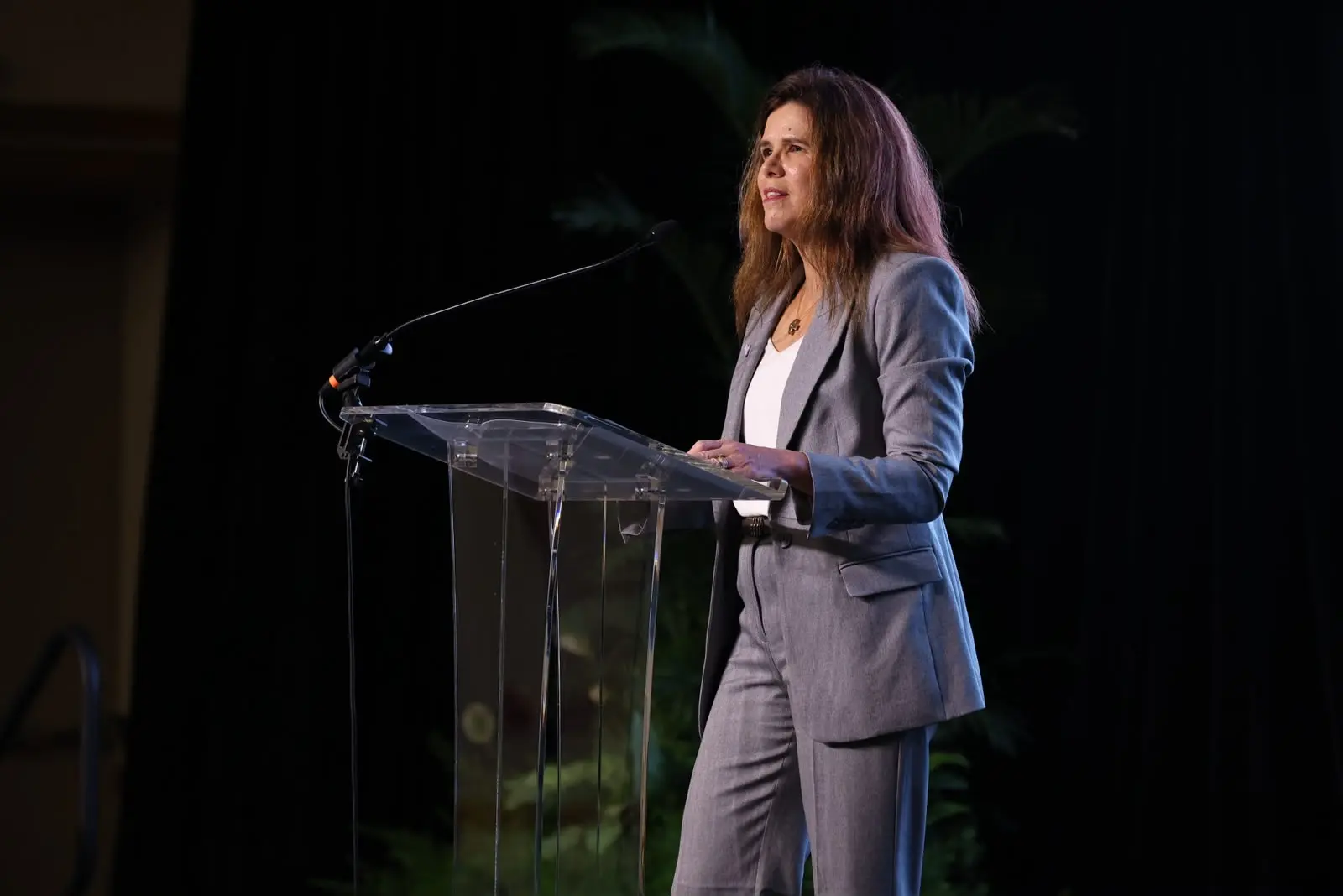
Good morning, everyone.
Welcome to AMCHAM T&T’s 4th Annual ESG Conference. We thank everyone for their attendance today as we embark on another important conversation about the future of our businesses and, quite frankly, the future of our country.
Our theme this year is “Navigating Uncertainty: Sustainability, Resilience and the Future of Business.”
I think we can all agree that there is heightened uncertainty these days - from changing global markets to geopolitical tensions to rising expectations from consumers and investors, and the constant pressure to do more with less.
Here at home, we are also having important conversations about the future of our economy: how we create new opportunities, strengthen existing industries, and how those conversations lead to us building an economy that can withstand the shocks that we know will inevitably come.
But I do not want to dwell too much on uncertainty this morning.
Because while there are challenges in front of us, there are also real reasons for optimism.
We are seeing positive signs emerging in our energy sector. At the same time, technology continues to present enormous possibilities for diversification. And perhaps most importantly, there is a growing recognition that the future of our economy cannot simply be about maintaining what we have. It has to be about building what comes next.
Let me be clear, in case there is room to misunderstand what I am saying. We have developed world-class industries in T&T. Banking and Finance, Gas and Gas processing, Petrochemicals, manufacturing, and others. We need to grow these industries while simultaneously building new ones.
So, the conversation cannot be petrochemicals or data centres. It must be both. It cannot be manufacturing or services; it must be both. It can't be finance or tech; it must be both. And at both the firm level and the sectoral level, growth must be achieved in sustainable ways – sustainable for the planet, sustainable for people, and sustainable for profits.
That is where ESG becomes so important.
Because when things become difficult, it is easy to view things like environmental responsibility, good governance, social impact, and employee well-being as the “extras” – the things we will get to when business conditions improve.
But these are not extras. They are the foundations of good business.
ESG, at its heart, is about asking some very practical questions:
How do we operate responsibly? How do we manage risk before it becomes a crisis? And how do we ensure that we create value by the strength, resilience and sustainability of the businesses and communities we leave behind?
You see, various studies show that ESG is good for business. But there is a caveat.
Companies that integrate financially material environmental, social, and governance factors into strategy, operations, and risk management tend, on average, to perform at least as well as—and often better than—companies that do not. Box-ticking doesn't work. A thoughtful, purposeful ESG integration strategy that aligns with your individual business objective does work. It positively impacts the bottom line.
When uncertainty increases, that big picture approach becomes more important. Because resilience is not simply about surviving disruption. It is about being prepared enough to seize the opportunity that follows it.
And that brings us to a much bigger question.
What kind of country do we want to build – and what kind of country do we want to leave behind for the generations that come after us?
This requires ambition. It requires us to be willing to think beyond what is immediately possible and begin imagining what could be possible.
That is why I am particularly pleased that our agenda today features The Honorable Jearlean John - Minister of Works and Infrastructure as our Feature Speaker.
Her perspective comes at an important moment as Trinidad and Tobago considers what it will take to revitalise and reposition our economy.
We know Government’s revitalisation agenda is ambitious. And ambitious goals will always come with difficult questions, difficult decisions and, inevitably, some uncertainty. But perhaps that is exactly the mindset we need.
Rather than allowing the scale of the challenge to weigh us down, let the scale of the ambition inspire us. Let it push us to build. To dream. To experiment. To innovate. And, most importantly, to do.
Because transformation does not happen simply because we have identified the problems. It happens when we begin building the solutions. Too many times, we focus on the reasons why we shouldn't do something. But in so doing, we forget the danger of doing nothing.
Today the developed world is grappling with the problem of how to cope with aging populations. How to care for people who are living longer than expected. In hindsight, does that mean we shouldn't support medical advances that have enabled people to live longer, generally healthier lives? Of course not.
So, when we are talking about new industries, yes, we must identify the potential negative impacts and actively work to mitigate them, but we can't be opposing for opposing sake or because of someone else's agenda.
And that is why the conversations we will have today matter. Because these conversations are not simply about ESG as a concept. They are about how we apply these principles to the very real challenges and opportunities in front of us.
Take environmental approvals and assessments, for example.
For a business looking to build a new facility, expand its operations, or invest in new infrastructure, an efficient and predictable approvals process matters. But so does ensuring that development does not create environmental costs that someone else has to absorb later.
When we get that balance right, everyone benefits.
Businesses have greater certainty to invest. Communities benefit from development that is responsibly planned. And the country protects the natural assets – our land, water, coastlines and ecosystems – that support industries and livelihoods for generations.
That is sustainability in practice. It is not about stopping development. It is about making sure that the development we pursue can stand the test of time.
The same principle applies to governance and compliance.
Strong governance is not simply about having the right policies sitting in a folder. It is about knowing who is accountable, understanding where risks exist, and having the systems in place to make good decisions before a problem becomes a crisis.
When more businesses operate this way, the benefit extends beyond individual companies. It strengthens confidence in our institutions, our markets, and our economy.
Financing is another critical piece of the puzzle.
Businesses cannot become more sustainable or resilient simply because we agree that they should. They need access to capital to make the necessary investments.
Whether that means upgrading equipment to use less energy, strengthening infrastructure, adopting new technologies, improving water efficiency, or preparing for climate-related disruptions, these investments can make a business more efficient today and more prepared for tomorrow.
And increasingly, the conversation is moving beyond the immediate cost of that investment to the longer-term value it creates.
Remember the cost of preparing for disruption is often far less than the cost of recovering from it.
Sustainable and resilience financing can therefore help businesses protect their operations, reduce risk, improve efficiency and position themselves for new opportunities – while also directing capital toward the kind of development we want to see in our economy.
And then we come to the Orange Economy, which I think offers us a particularly exciting perspective on our future.
When we talk about diversification, we often think about finding the next major industry or attracting the next major investment.
But sometimes, the greatest opportunity is already here.
It is in our people.
It is in the designer creating a brand that can be sold internationally. The filmmaker telling a Trinidad and Tobago story to a global audience. The musician building a career beyond our shores. The software developer creating a solution that can be scaled across the Caribbean. The creative entrepreneur turning an idea into a business.
These are not simply creative pursuits. They are economic activity. They are intellectual property. They are exports. They are jobs. They are opportunities for young people to build careers in industries that did not exist in the same way a generation ago.
And technology makes that opportunity even greater.
A young entrepreneur in Trinidad and Tobago can now create something here and potentially reach customers anywhere in the world.
That is diversification. That is innovation.
And in a country that is looking to diversify, that matters.
So, whether we are talking about how we use our land, how we govern our companies, how we manage what we consume, how we finance our future, or how we unlock the creativity of our people, these are not separate conversations.
They are pieces of the same puzzle. They are about building businesses that can adapt. Building communities that can withstand disruption. Creating opportunities that are inclusive and lasting. And developing an economy that does not simply respond to change, but is capable of creating its own opportunities within it.
And ultimately, that is what I believe ESG gives us.
It gives us a framework for navigating uncertainty – not by trying to predict everything that is going to happen, but by building the kind of businesses, institutions and economy that are prepared for whatever comes next.
Because the question before us is not simply: How do we get through uncertain times?
It is: How do we use this moment to build something better?
That is the opportunity in front of us. And that is the future of business we are here to shape.
Because regardless of what acronym we use, our responsibility does not change.
People matter. The planet matters. And purpose matters.
If our people are not thriving, our businesses cannot thrive.
If our environment is not protected, our economic progress will eventually come at a cost.
And if we lose sight of purpose, we risk building an economy that grows – but does not necessarily progress.
So, as we navigate uncertainty, I encourage all of us not to retreat into caution.
Let us use uncertainty as a reason to become more thoughtful, more innovative, and more resilient.
And let us never lose sight of what ESG ultimately promises – not a checklist, not another compliance exercise, but a different way of thinking about how we build businesses, how we build economies, and how we build the future.
Thank you, and I look forward to the conversations ahead.