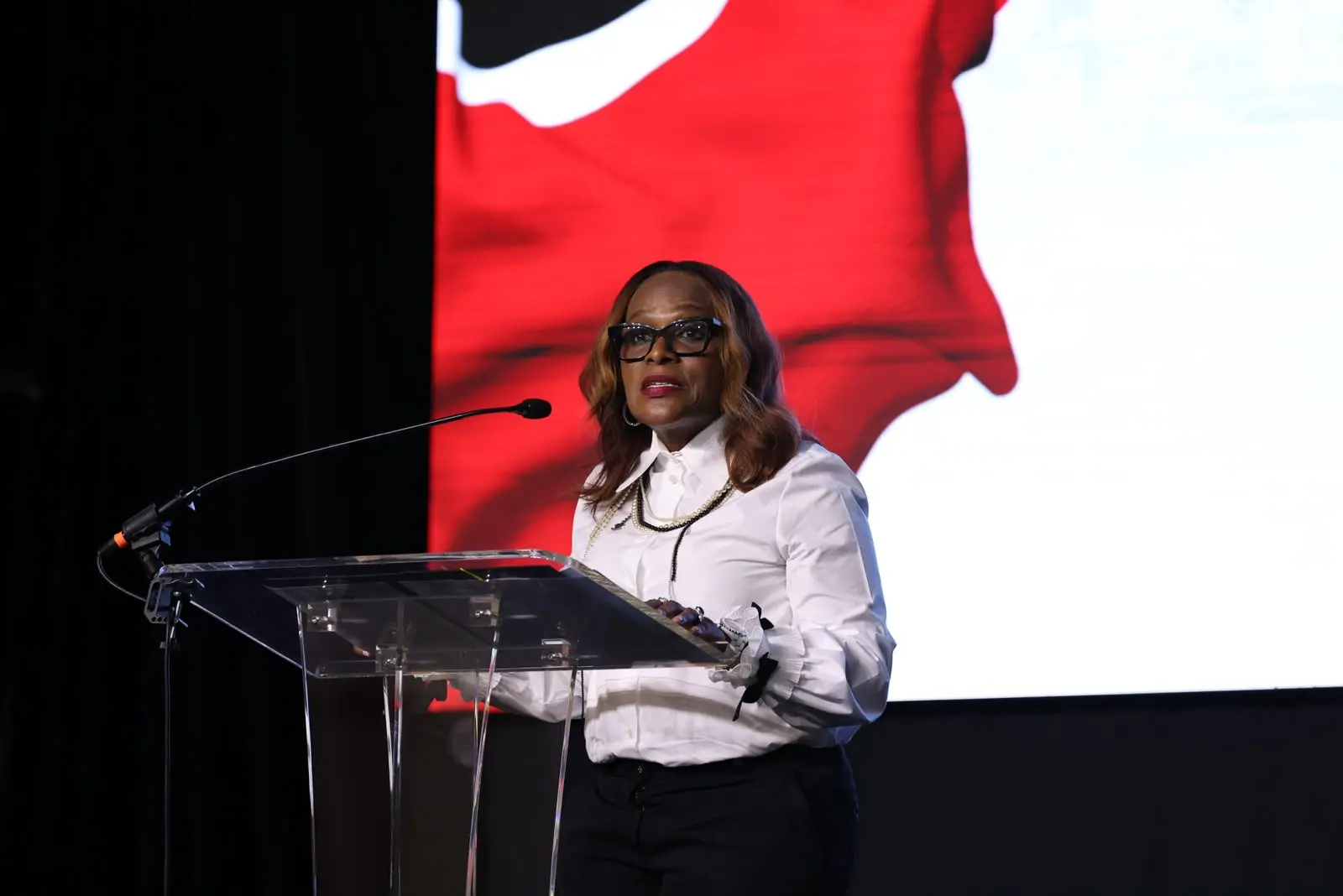
 Good morning,
Thank you for the invitation to speak today. When I looked at the theme, “Navigating Uncertainty: Sustainability, Resilience, and the Future of Business,” I knew my presentation would not be built on Environmental, Social, and Governance buzzwords and C-suite theories.
At the heart of this theme is a very practical question or response for us as a people in Trinidad and Tobago: how do we prepare ourselves, our businesses and our country to keep moving when circumstances change?
The way I see it, you cannot navigate uncertainty if you have not built resilience, and you cannot build resilience on systems and behaviours that are fundamentally unsustainable.
So let me take this theme apart and hand it back to you in three pieces. Not as a framework, but as an order of work, because each one connects directly to the way we live, work, invest and govern in Trinidad and Tobago.
● First, focus on what we can control.
● Second, reframe the unknown, so that uncertainty stops being something we brace for and becomes something we plan around.
● Third, build sustainable resilience, because resilience that cannot be maintained is not resilience at all. It is recovery.
So, let us start where the work actually begins.
FOCUS ON WHAT WE CAN CONTROL
I want to draw your attention to the screen behind me. Look at this image. Let it sink in.
I am starting this presentation by talking about a drain.
I know it seems out of place at a forum of this nature.
Nevertheless, bear with me!
On the 17th of August, the Highways Division undertook drain cleaning works on South Quay, Port of Spain.
Let me tell you what we found.
As you can see in the image, the drain was filled with plastic bottles, garbage and waste. The silt trap was packed solid with grease.
Not blocked. Completely sealed.
Here is the part I want this room, in particular, to sit with. That grease came from businesses: establishments pouring cooking oil and kitchen waste straight into the municipal drainage system, day after day, as though the drain was an extension of their kitchen.
So… when the rain comes, and Port of Spain floods:
● Lower Edward and Henry Streets,
● South Quay City Gate,
● Sackville Street,
● London Street,
● St Vincent Street,
● Richmond Street by Unit Trust Corporation; and
● In front of the Central Bank on Independence Square, we will blame the weather.
We will blame the Ministry of Works and Infrastructure or,
We will blame climate change.
But that drain was not sealed by climate change. In fact, that drain was sealed by human habits… human beings making the conscious decision to throw garbage and oil into the drainage system.
In fact, as we sit here in the Hyatt, if it rains for half an hour, what we will need in Port of Spain is Noah’s Ark.
We cannot build resilience on indiscipline. We cannot have a serious conversation about sustainability and the future of business while treating the environment immediately outside our own door as somebody else’s responsibility.
Look at this!
· Drain cleaning works at UTT POS (August 24), filled with silt and debris. That blockage contributes to flooding along Wrightson Road, French Street, and other parts of POS.
· Wednesday, August 19th, on my weekly early morning visits, the Ministry’s team was on the Manzanilla Stretch into Point Radix. A beautiful beach if and when it's cleaned. As far as the eye could see, litter was everywhere. I did not wait to report it to the Ministry of Local Government; I instructed and took action…so this session today cannot be framed around an intellectual conversation about the environment, because there are many things we can control.
Although this was not the responsibility of the Ministry of Works and Infrastructure, I instructed that a team be sent down to the Point Radix beach from August 28 to clean up the area.
This is what sustainability looks like. We have to build it from the ground up. We have to decide that anything cannot go…
So allow me to ask: Why is everything the Government’s job?
How many intellectual conversations must we continue to have? It is simple…Work takes work. Work is an action word. Work is not something you sit on… and sometimes I feel that one of our challenges in Trinidad and Tobago is simply the act of doing nothing.
We cannot talk seriously about sustainability while ignoring the very rules designed to protect our infrastructure and the environment.
Deliberately building over drains.
Deliberately encroaching on highway reserves.
Deliberately ignoring required setbacks and asking the Ministry to fix drainage after.
Deliberately constructing large commercial infrastructure first and asking permission after.
This might very well apply to some of you sitting in this room.
Sustainability cannot mean following the rules only when they are convenient to you.
Because I like context…Let me give you another example.
At the base of the Hilton, an international flagship hotel, there was illegal vending and a skip bin piled with garbage and litter everywhere.
A complete mess!
For months, it sat there.
Somebody must have put it there.
Somebody must have seen it.
Somebody could have removed it.
Somebody could have cleaned it.
Somebody could have enforced a standard.
Notice how many times I said SOMEBODY
Everybody was watching it, including the Hilton, but Nobody was taking responsibility for it.
Eventually, my Ministry intervened on the weekend of July 05th to clean the area.
I have to ask: how is that sustainable?
If I am prepared to stand up and take responsibility, even for spaces outside of the Ministry’s direct remit, what are you doing?
We speak a great deal about corporate social responsibility, Environmental, Social and Governance (ESG) and sustainability, but corporate social responsibility should not be performative. It should be a genuine interest and commitment to do better for Trinidad and Tobago.
From the ground up…This is how I contribute to sustainability.
Just last week I took a young man to his first day of school myself.
Additionally, we provided full book lists for over 200 students and I cannot tell you what was sponsored by the private sector.
A significant part of that sponsorship came from our State agencies, including PLIPDECO and Paria Fuel Trading Company Limited.
If we are serious about sustainability, then investing in the future- our human resources from a young age is where you put your money.
It is part of the work.
Ladies and gentlemen, when we talk about resilience and sustainability, we cannot overlook the FUNDAMENTALS. This does not come only from a policy position.
IT IS BASIC HOME TRAINING.
I grew up in Charlotteville. We were not rich people, but we were squeaky clean. I remember the Saturday morning instruction from my grandmother:
“Go out there and sweep that yard so I could see my face in it.”
Now look at the irony. She is sending me to sweep a dirt yard, and when I am finished, she must be able to see her face in it.
But that is the metaphor. She was teaching me that the state of the space you are responsible for is a public statement about who you are, and by extension, who we are as a people.
Cleanliness engenders discipline. Discipline engenders order. It is only out of order that sustainability and resilience can flow, and we can truly be competitive.
To compete globally, we must look around and see where the competition is. Who are we competing against?
Dubai is where you have to put our marker!
Since the 1990s, we have used Singapore then Dubai as examples of the best airports in the world: 95.2 million passengers in 2025 across 454,800 total flight movements, connected to 291 destinations across 110 countries via 108 international airlines.
Saudi Arabia is where you have to put our marker!
Today they sit among the top tier of nations in artificial intelligence. They rank second globally in data centre market attractiveness. That market is valued at approximately USD 2.08 billion in 2025. Around 40 operational colocation data centres already meet Tier III standards, with a national target of 1.5 gigawatts by 2030.
Singapore, Vietnam…these are emerging economies where we need to put our marker!
The success of these countries is not based on luck. They are deliberately positioning themselves to welcome capital.
Resilience does not come just so. Resilience comes from a people willing to accept a vision, and willing to do the work that vision requires.
BECAUSE ONCE AGAIN …WORK TAKES WORK
Fundamentals alone are not the strategy. The strategy must also include how we treat with the unknown, and whether we can reframe our thinking to make this country more competitive on the global market.
The bottom line is this. Capital goes where it is welcomed.
REFRAME THE UNKNOWN
What is the unknown?
We don't know if there will be sustained unrest in the Middle East. We don't know what changes are to come on the global market. But we have to be ready and position ourselves. So even if we are not wealthy now, we can start the work that will allow us to grow and be seen as a serious investment hub.
Look at the signals already in front of us.
Through the work of the Honourable Sean Sobers, Minister of Foreign and CARICOM Affairs, and other senior Government officials, Trinidad and Tobago has secured a series of oil and gas wins since May 2025:
Gas deals
● US licences secured for Dragon and cross-border gas (October 2025 and February 2026) approximately 3.4 trillion cubic feet, or 96 billion cubic metres of gas, for Atlantic LNG
● Loran Phase 1 gas coming to T&T (June 2026) — 1.7 trillion cubic feet, 100% processed at Beachfield, with first gas targeted for 2027
● NGC-Perenco: three gas supply deals (February 2026) securing roughly 25% of NGC's total gas supply
● NGC-EOG gas supply agreement (January 2026) 425 million standard cubic feet per day for the domestic market
● NGC's purchase of the TROC compressor from bpTT (January 2026), bringing it into State ownership to keep gas flowing reliably on the national pipeline to LNG and industry
● Incentives for small offshore gas fields (2026) — an 8% royalty plus a 130% capital allowance to bring new gas online faster
Oil deals
● ExxonMobil ultra-deepwater contract, TTUD-1 (August 2025 and June 2026) — over 2,700 square miles, with Occidental joining at 10%
● Perenco contracts upgraded to revive mature oil and gas fields (April 2026) — seven platforms across Blocks 2(c) and 3(a), Angostura and Ruby, at roughly 300 million standard cubic feet per day
● Heritage Petroleum growth plan, targeting 74,600 barrels per day by FY2029, up from 55,271 in October 2025
As a Government, we recognise that there is still serious energy potential around Trinidad and Tobago, and international interest in developing it.
That is how you reframe the unknown. You look at what you have.
You look at what can be unlocked.
You look at what has been sitting idle.
You look at the expertise that already exists in your people. Then you move.
But reframing an opportunity is only useful if it ends in something built.
In August, the Deputy Secretary of State of the United States, Christopher Landau, attended the recommissioning of the Ibis Steel Company of Trinidad and Tobago, the local subsidiary of Pinnacle Steel and Vanadium Corporation.
With an initial investment of US$250 million, and a further injection of US$750 million to facilitate expansion and modernisation, first production is targeted for the end of 2027.
The closure of the plant in 2016 left six hundred and forty-four workers on the breadline. Under this new iteration, the project is expected to create three hundred and fifty jobs during the refurbishment phase, five hundred permanent jobs once production begins, and approximately one thousand permanent jobs at full expansion.
And the output is not only steel. It is also vanadium and titanium.
Consider what that means. A country of 1.4 million people could supply the equivalent of up to fifty per cent of United States consumption of vanadium. That would make us integral to the supply chain of the largest economy on earth. Not as a supplicant, but as a supplier.
This Government looked at something we already had: furnaces, berths, rail, power infrastructure, industrial land and, most importantly, people with the knowledge to operate it.
We have done it, but now we must expand it.
That is what sustainability looks like when it becomes real. It is not just keeping an asset alive. It is connecting that asset to jobs, foreign exchange, skills, supply chains and a future for communities.
The same logic applies to the Pointe-a-Pierre Oil refinery.
Negotiations and investor discussions are ongoing. Serious people with serious interests come here, and they are amazed that a country with our energy history has a refinery that has sat idle since November 2018. That is close to eight years. That should make all of us uncomfortable, because an asset of that scale must at least be examined through the lens of what value it can still create.
The potential is not only the refinery itself. It is the ecosystem around it: operations, maintenance, engineering, fabrication, transport, shipping, laboratory services, contractors, suppliers, training and the small businesses that grow when industrial activity grows.
Ladies and gentlemen, building sustainability does not happen in conference rooms alone. This conversation matters, but it has to end in execution.
I can tell you, without fear of contradiction, that when I go into these negotiations, I go all in for the people of Trinidad and Tobago. I tell investors plainly: when you are talking about oil and gas in this country, you are working with some of the best expertise in the world. We know this business. We have built capability over generations. Now we have to match that technical ability with speed, service and execution.
This brings me to my third point.
BUILD SUSTAINABLE RESILIENCE: TURN OPPORTUNITY INTO SYSTEMS THAT LAST
What attracts capital is precisely what makes a country resilient: Order, Predictability, excellence, discipline, cleanliness, and standards that hold when nobody is watching. An investor reads a dirty country the same way they read a delayed approval, because both tell them the same thing about how a place is run and functions. Our job is to create the conditions that make an investor confident.
We have already started the work, and many of you in this room would have read about the signing of several Memoranda of Understanding with United States companies.
● A framework with Ernst & Young for the development of a 300-megawatt data centre using their Energy to Intelligence platform.
● A framework with Hummingbird AI Holdings for a proposed 150-megawatt artificial intelligence infrastructure and data centre facility, with the potential to expand to 500 megawatts.
Together, those represent potential investment in excess of five billion United States dollars.
Under the Revitalization Plan, a mega development programme, the Ministry has identified 13 development nodes and structured 129 projects over a ten-year horizon, representing an investment of approximately TT$112 billion. This is the largest coordinated infrastructure rollout in the history of the Caribbean.
The Expression of Interest process attracted 965 submissions, amounting to more than 190,000 pages of proposals from local and international partners. The market has taken notice.
The evaluation process is complete, and the Ministry is now advancing Requests for Proposals for shortlisted proponents.
Flagship projects under the Revitalisation Blueprint include:
● The San Fernando to Mayaro Highway, connecting the south and unlocking economic opportunity for communities long overlooked.
● A world-class waterfront and financial district at Invaders Bay, positioning Port of Spain as a genuine regional business hub.
● Health City facilities in both North and South Trinidad, because quality healthcare should not depend on where you live.
● Modernisation of the Port of Port of Spain and multimodal transport hubs, because the efficient movement of goods and people is foundational to a functioning economy.
● A 500-acre Tamana Prison Campus and a unified 40-acre National Security Complex, a significant investment in justice and safety for every community.
At its peak, the Revitalisation Blueprint is projected to generate 72,000 jobs. Let that figure register. Seventy-two thousand jobs. Not temporary relief work, but construction, engineering, procurement, logistics, and the businesses that grow up around them. Many of them are yours.
Ladies and gentlemen, the Ministry of Works and Infrastructure will build better roads. We will repair bridges. We will clean the existing roads and highways.
We will clear the watercourses. We will deliver ports, if that is the mandate. We will drive the projects that will help revitalise this economy.
That is our work, and we will do it.
But this Government cannot legislate pride. We cannot legislate discipline. We cannot legislate shame. We cannot legislate a burning ambition to be excellent, to be competitive, to just hustle!
So when you leave here today, remember the three ideas I started with: control what is in your hands; reframe the unknown; and build resilience through work systems, because the power you have must be shared, it has to be collective. Power is not about how far you have come singularly, power is about who you brought along.
I try to do that, and recently I was looking at a speech delivered by the most unlikely CEO of CHANEL LUXURY Brand. In making a point, she quoted Ilya Prigogine, a Nobel Prize-winning chemist.
“When a complex system is far from equilibrium, its the small islands of coherence in a sea of chaos that have the ability to inspire and uplift everyone else.”
I also want to leave you where many lessons and the fundamentals began for me. In a small village in Tobago, on a Saturday morning, with a broom in my hand and a resilient woman, Ma Maggie, standing on the step telling me:
“Sweep that yard until I can see my face in it.”
I did not understand then that she was teaching me about excellence.
Perhaps that is what Trinidad and Tobago needs from all of us now.
To sweep our own yard.
To take responsibility for what is in front of us.
To raise the standard.
To do the work so well that, when we are finished, we can see our own faces in it.
Ladies and gentlemen, this should be our baseline for building sustainability, resilience and navigating uncertainty.
Because capital goes where it is welcomed.
Opportunity goes where there is order.
Confidence goes where there are standards; and Resilience is built where people take responsibility.
Let the true work that matters begin.
I thank you.