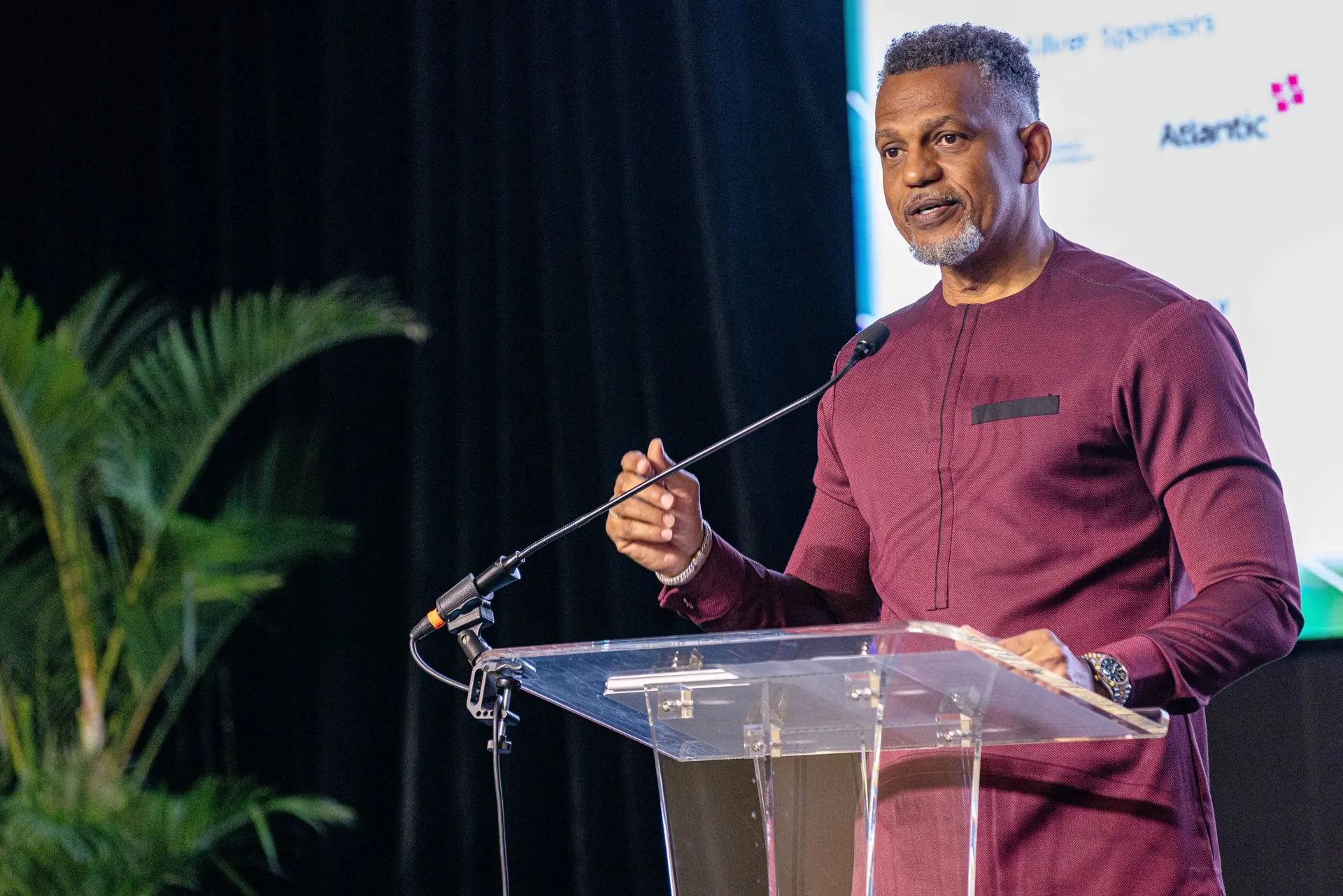
Good morning.
I wanna first, of course, begin by thanking the American Chamber of Commerce of Trinidad and Tobago, and particularly Mr. Tewarie for the invitation to speak at this year's Environmental, Social and Governance Conference.
An opening slot at a conference built around ESG themes carries a certain responsibility, one which I and the Caribbean Development Bank fully embrace. ESG has shifted from the margins of corporate strategy to its core, driven in large part by a climate vulnerability our economies can no longer treat as abstract.
However, if we are being honest, greater attention has not always brought greater understanding. A Pricewaterhouse survey of directors across this region released just this year makes this point precisely. It shows that two-thirds say ESG is embedded in their strategy.
2/3rds of regional leaders, ESG is embedded in their strategy. Yet only 44% actually report on ESG measures, a figure unchanged in two years. There's no doubt that reporting matters, but the real value lies in how these considerations shape decisions about risk, investment, and the kind of business you want to build.
That is precisely the discipline that resilience requires. So let me state the premise this conference rests on, and the one I want these remarks to also rest on. It is that uncertainty is no longer an occasional disruption.
It is the operating environment within which Caribbean governments, businesses, and citizens must now plan for and prosper within. That uncertainty comes wearing many labels, environmental, social, and governance among them. But it is one and the same challenge.
If uncertainty is the environment we now operate in, resilience cannot be occasional either. It has to be built into how we plan, invest, and govern as a matter of course, rather than a reaction to the last crisis. That is not the most comfortable starting point I know for a business address, but it is an honest one.
The pressures our region faces did not originate here, even though here is where they tend to land hardest. We are navigating sustained economic volatility and geopolitical tensions, in which shifting trade and tariff policies threaten the terms of trade of small economies like ours with little warning. We are living through accelerated climate change with natural hazards rising faster than most of our institutions were designed to absorb.
And artificial intelligence is reshaping how firms compete and create value, often faster than regulatory and skills frameworks can adapt. None of these forces respects the size of the economy it touches, and their effects are not felt evenly. Growth across CDB's board member countries, excluding Guyana, slowed to an estimated 0.6% in 2025, down from 1.4% in 2024.
Including Guyana, growth reached 4.7%. For 2026, our outlook projects 1.1%, excluding Guyana, and 6.2% when we include Guyana. Fiscal risks remain pronounced in a number of highly indebted countries with limited buffers. A country entering hurricane season without fiscal space recovers more slowly, borrows more expensively, and is more exposed to the next shock.
This is the cycle our economies must break. I want to be equally direct about the other side of the ledger. Stronger than expected tourism outturns are accelerating investment.
Progress on the renewable energy transition is reducing our fiscal exposure to imported fuel. Trinidad and Tobago's own path, managing a mature energy sector while pursuing diversification is a version of the same challenge every borrowing member country is working through. Put those two halves together, the exposure and the momentum, and there is only one honest conclusion to draw.
The challenge before us is not how to eliminate uncertainty, nor whether a given policy or investment removes uncertainty, because nothing will, but how to build resilience that allows us to thrive despite uncertainty being present. Part of the answer lies in the policy choices governments make, strengthening implementation capacity so that financing already committed translates into completed projects, and creating an enabling environment so that innovation can take root and provide a firm basis for export diversification.
Technology adoption is a third leave for this region cannot treat as optional. Accelerating the pace of digital adoption by governments in the Caribbean must be an imperative, as the rate of uptake has in fact lagged for us SIDS. But government policy alone is not sufficient.
Building resilient economies requires a private sector that is innovative, competitive, and actively engaged in national development. Successful private sectors do more than advocate for business interests. They work collectively with governments to identify constraints, shape policy, support implementation, invest in skills and innovation, and promote good governance.
And institutions like the Caribbean Development Bank can help. We see our role in four parts, a trusted development partner to our 19 borrower member countries, a catalyst for sustainable investment, a convener of partnerships, and a provider of both knowledge and finance.
Ladies and gentlemen, ESG is not something we promote from the side lanes. It is embedded in how we operate, invest, and deliver development impact across the region.
In 2024, we undertook a comprehensive ESG and sustainability materiality assessment to help shape our strategic direction and ensure that sustainability considerations were integrated into our decision-making. In February this year, our board of governors approved that 10-year strategic plan built around three pillars, social, economic, and environmental resilience.
Two of those pillars are this institution's own response to the E and the S that bring us together this morning. The G comes from a different thread of our strategy, an operational priority of building strong institutions. Beyond this, we have established ambitious financing targets committing 30% of our total financing and 35% of our concessional resources to climate adaptation and mitigation.
ESG principles are also embedded in our lending operations. Every project financed by the bank undergoes environmental and social review procedures designed not only to safeguard against harm, but to strengthen our clients' capacity to manage risk and build resilience. This approach has supported investments ranging from early warning systems in Belize and Trinidad and Tobago to disaster management reforms in St. Vincent and the Grenadines, environmental governance initiatives in Guyana, climate resilience programs in Dominica, and post-disaster recovery support across the Caribbean.
Our agenda policy and operational strategy make gender-responsive design a requirement, not an afterthought. From a water project in Belize built with gender-inclusive workforce planning to a technical and vocational training in St. Vincent and the Grenadines designed around gender-responsive access. We are assessing the implementation bottlenecks that continue to constrain development across our member countries, helping institutions deliver results more effectively.
This addresses the governance pillar of ESG by improving accountability, resilience, and institutional performance. As many of you are aware, CDB is regularly assessed by international credit rating agencies. And a key part of those discussions is ESG.
Because investors and potential creditors want to know that their resources are being entrusted to an institution that is managing environmental, social, and governance issues responsibly. They want evidence that we are identifying risks, operating transparently, and positioning ourselves for long-term sustainability and impact. Against this backdrop, the bank issued its first sustainability bond in 2025, raising 100 million Swiss francs on the Swiss market to finance projects in climate resilience, renewable energy, water management, education, food security, and MSME development.
ESG is an integral component of our business proposition. And of course, we pass on these benefits. We are able to use our credit rating to provide concessional resources, help de-risk transactions, and partner with other DFIs like IDB, the World Bank, and CAF to provide financing at scale.
But let me turn now to what may be our greatest untapped advantage, collaboration. Yep, collaboration. The challenge we face, the challenges we face, from climate risk and energy security to trade and competitiveness do not stop at national borders. Neither should our solutions. That is why collaboration is not just good citizenship. It is in fact a comparative advantage.
No Caribbean country can build resilience alone, but together, we can achieve a scale and impact that none of us can achieve individually.
What if we had, think with me for a moment, what if we had a single digital space where a young tech entrepreneur in Antigua can launch an app that scales instantly across 15 states without roaming barriers or regulatory walls?
What if food insecurity was a thing of the past because the fertile lands of Guyana and Belize could feed the rest of the region?
And of course, energy. Where geothermal from St. Kitts and Dominica could feed into a regional energy mix that reduces the uncertainty of volatility.
This is where AMCHAM Trinidad, and Tobago plays an important role. In times of uncertainty, forums like this help bring together business leaders, policymakers, and development partners to share ideas, build partnerships, and develop practical solutions to share challenges. Ultimately, resilience is a team sport.
The businesses and economies that thrive in the years ahead will be those that not only compete effectively but collaborate strategically. In an uncertain world, that may be our greatest advantage.
Let me close with a simple thought.
Uncertainty is not an occasional challenge. It is a reality in which we operate. In that environment, resilience is not a luxury. It is a necessity.
ESG is one of the most powerful tools we have to build that resilience.
Businesses that embrace ESG are better equipped to manage risk before it becomes crisis, improve efficiency and control costs, strengthen their reputation, and build the trust that is so critical in uncertain times.
They're often better positioned to attract investment, win new business, and recruit and retain talented people who want to be part of organizations with a clear sense of purpose and long-term vision.
The E, the S, and the G are not separate conversations. They are the foundations of resilient businesses, resilient institutions, and resilient economies.
Those who get them right will not simply withstand uncertainty. They will be better positioned to grow, innovate, and thrive because of it. That is the opportunity before us, friends.
So let me just wish you a productive and thought-provoking conference. And I look forward to the ideas, partnerships, and actions that will emerge over the next two days. And I just ask you to bear in mind that ultimately, the people who will benefit the most from what you do over these next two days are not in this room, but they are absolutely counting on you, absolutely counting on all of us to get it right.
Friends, I thank you very much.